
Amaravati (Economy India ): Andhra Pradesh on Monday positioned itself as one of India’s most ambitious laboratories for technology-led governance as Chief Minister N. Chandrababu Naidu briefed Bill Gates on a wide range of digital governance, healthcare, data integration, and capital city development initiatives.
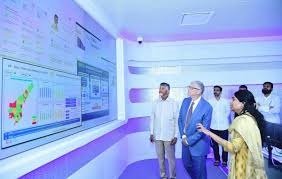
The interaction took place at the state secretariat in Amaravati, where Gates, Chairman of the Gates Foundation, was given a comprehensive presentation on Andhra Pradesh’s Real-Time Governance System (RTGS)—a flagship initiative that integrates data across departments to enable faster decision-making, transparent service delivery, and outcome-based governance.
According to an official statement, Gates closely observed how technology is being deployed to track public service performance, assess policy outcomes, and deliver citizen-centric governance at scale.

Real-Time Governance: The Backbone of Andhra Pradesh’s Administrative Model
At the heart of the presentation was the Real-Time Governance System, which the Andhra Pradesh government describes as a transformational shift from reactive administration to predictive and proactive governance.

Chief Minister Naidu explained that all major government departments are connected through a unified Data Lake architecture, allowing live data flows on welfare delivery, infrastructure progress, revenue collection, healthcare indicators, and grievance redressal.
Key features of the RTGS include:
- Integration of departmental data into a single digital command framework
- Live dashboards tracking scheme implementation and service timelines
- Automated alerts for delays, deviations, or inefficiencies
- District- and constituency-level performance monitoring
Gates was shown how the system enables administrators to identify problems in real time and intervene before service delivery failures escalate.
Officials said the system has significantly reduced turnaround time for citizen services while improving accountability at multiple levels of administration.
‘Aware 2.0’: Data-Driven Feedback and Policy Calibration
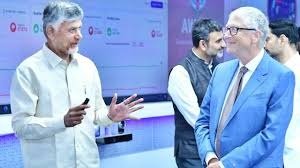
The Chief Minister highlighted the role of the ‘Aware 2.0’ platform, which collects real-time information from the field and captures citizen feedback on government schemes.
According to Naidu, the platform allows the government to evaluate whether policies are achieving intended outcomes rather than merely tracking expenditure.
“Governance today is no longer about announcements. It is about measurement, feedback, and correction,” Naidu told Gates during the presentation.
Through Aware 2.0:
- Public opinion is sampled regularly on welfare schemes
- Ground-level implementation gaps are flagged instantly
- Course correction is undertaken based on measurable outcomes
The system also supports Key Performance Indicator (KPI)-based governance, under which departments are assessed against clearly defined targets.
Estimating Growth Through Data: GSDP and Performance Metrics
Naidu explained that Andhra Pradesh now estimates its Gross State Domestic Product (GSDP) using continuous data inputs rather than static annual projections.
Sector-wise indicators—ranging from agriculture output and industrial production to services activity—are tracked digitally, providing policymakers with near real-time visibility into the state’s economic trajectory.
This data-centric approach, officials said, helps the government align infrastructure spending, employment generation, and social welfare policies with actual economic conditions.
Digital Land Records and Transparency Through QR Codes
When Gates raised questions about land record security—a major governance challenge in many developing economies—Naidu outlined Andhra Pradesh’s digital land management framework.
The state has implemented:
- Fully digitised land records
- Secure databases with audit trails
- QR code-enabled access to land documents
According to the Chief Minister, the QR code system enhances transparency by allowing instant verification of land ownership details while reducing disputes and scope for manipulation.
Gates reportedly took note of the initiative as a scalable model for land governance in emerging economies.
Revenue Collection and GST: Efficiency Gains Highlighted
During the interaction, Gates remarked that Andhra Pradesh’s tax collection mechanisms appeared robust and efficient.
Naidu responded by attributing much of the improvement to the nationwide implementation of the Goods and Services Tax (GST), which has strengthened compliance, reduced leakages, and enabled data-driven revenue monitoring.
State officials said digital dashboards now track GST inflows in real time, allowing better fiscal planning and expenditure prioritisation.
Sanjeevani Project: Digitising Healthcare at the Grassroots
One of the most detailed discussions revolved around the Sanjeevani health records digitisation programme, being implemented in Chittoor district’s Kuppam constituency in collaboration with the Gates Foundation.
The project focuses on:
- Digital health records for citizens
- Regular tracking of blood sugar, diabetes, and other key health indicators
- Integration of diagnostic data with primary healthcare systems
Gates observed how frontline health workers enter medical data in real time and how the system enables early identification of health risks.
He appreciated the smooth implementation of the project and noted that affordable and accessible medical diagnostics could significantly improve healthcare outcomes for low-income populations.
AI and Bio-Design: Reimagining Healthcare Delivery
Naidu also briefed Gates on the government’s use of Artificial Intelligence (AI) to strengthen preventive healthcare.
According to officials:
- AI tools are being used to analyse health data trends
- Early warning systems are being developed for non-communicable diseases
- Predictive analytics supports targeted medical interventions
The Chief Minister further explained how bio-design principles are being applied to redesign service delivery—making healthcare more accessible, efficient, and patient-centric.
Gates reportedly said that technology-led healthcare models, if scaled responsibly, could transform public health systems across developing regions.

Amaravati: Building a Future-Ready Greenfield Capital
Beyond governance and healthcare, Naidu also presented the development roadmap for Amaravati, Andhra Pradesh’s greenfield capital city.
The vision includes:
- Smart city planning anchored in digital infrastructure
- Sustainable urban mobility and green energy systems
- Integrated governance platforms for municipal services
Naidu described Amaravati as a city designed not just for administrative efficiency but for long-term economic growth, innovation, and environmental sustainability.
The presentation emphasised that digital governance frameworks being tested across the state would be embedded into the capital’s urban design from inception.
Technology for Humanity: Naidu’s Broader Vision
Following the meeting, Naidu shared his reflections in a post on X, stating:
“Technology must serve humanity. Our Real-Time Governance System is transforming lives in Andhra Pradesh by accelerating governance and enabling ease of doing business.”
He recalled that his interaction with Gates in the 1990s had played a formative role in shaping his belief in technology-driven citizen empowerment.
High-Level Engagements and Institutional Dialogue
Earlier in the day, Gates was formally received at the state secretariat, where Naidu introduced him to members of the Andhra Pradesh Cabinet.
Gates later interacted with:
- IT Minister Nara Lokesh
- Deputy Chief Minister Pawan Kalyan
- Senior bureaucrats overseeing technology, health, and urban development
Officials said the discussions explored possibilities for deeper collaboration in digital public infrastructure, healthcare innovation, and data-led governance.
Economy India Analysis: Why This Visit Matters
Bill Gates’ engagement with the Andhra Pradesh government carries significance beyond symbolism.
Key takeaways:
- Andhra Pradesh is positioning itself as a model state for digital governance
- Data-driven policymaking is becoming central to administrative reform
- Healthcare digitisation and AI-led prevention offer scalable public health solutions
- Amaravati is being designed as a future-ready governance capital
For India’s broader policy ecosystem, the interaction underscores how state governments are emerging as critical innovation hubs for governance reform.
As India navigates complex challenges—from healthcare access and urbanisation to fiscal efficiency and service delivery—the Andhra Pradesh model offers a glimpse into how technology, when institutionally embedded, can reshape governance.
The engagement between Chief Minister Chandrababu Naidu and Bill Gates highlights a convergence of public policy ambition and global technological expertise—one that could influence governance frameworks well beyond the state’s borders.
(Economy India)