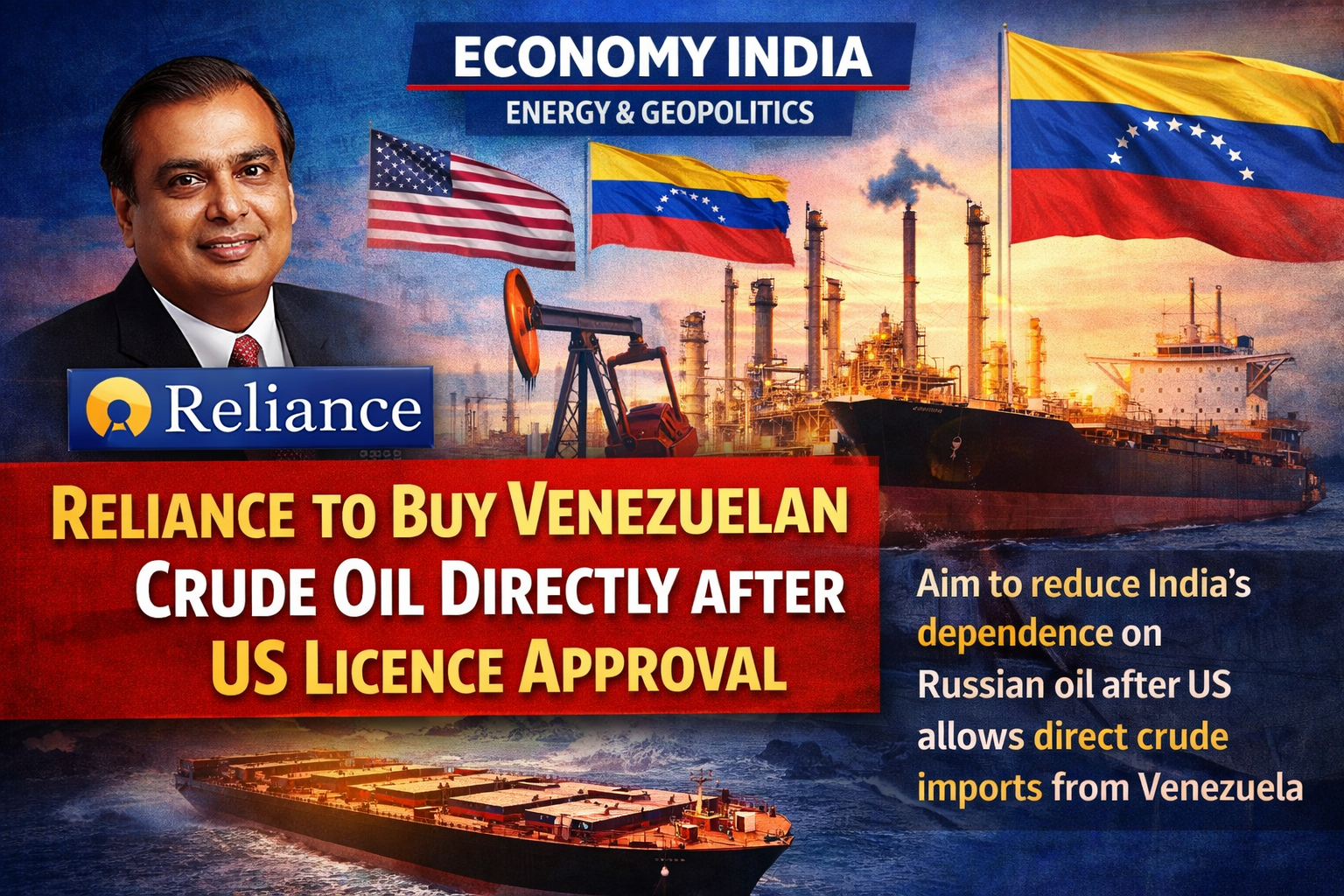

New Delhi (Economy India): India’s largest private refiner Reliance Industries is set to import crude oil directly from Venezuela, after reportedly receiving a licence approval from the United States, a move that could significantly reduce India’s dependence on Russian oil.
According to sources, the approval allows Reliance to procure Venezuelan crude without intermediaries, enabling higher import volumes and improved cost efficiency. While the company has not made an official announcement, the development follows a recent India–US trade understanding that places renewed focus on diversifying India’s crude oil sourcing.
🛢️ Why Venezuelan Crude Suits Reliance’s Jamnagar Refinery
Reliance operates the world’s largest refining complex at Jamnagar Refinery in Gujarat. Industry sources say Venezuelan crude, which belongs to the heavy crude category, is particularly well-suited for Jamnagar’s advanced refining configuration.
Processing heavier crude grades typically offers higher refining margins, as Jamnagar’s complex units are designed to efficiently handle such grades. Analysts believe this could enhance Reliance’s profitability amid volatile global energy markets.

🌍 US Clears Select Companies to Source Oil from Venezuela
Sources indicate that in late January, the US granted permission to select international companies, including Reliance, to import oil directly from Venezuela, despite long-standing sanctions imposed in 2019.
India had halted Venezuelan oil imports following US sanctions, which disrupted payment and logistics channels. Venezuela, a member of OPEC, holds the world’s largest proven oil reserves, though it currently contributes only about 1% of global oil supply.
🇮🇳 Government Push to Diversify Crude Imports
Earlier reports suggested that the Indian government has encouraged both public and private refiners to increase crude purchases from the US and Venezuela, in line with evolving geopolitical and trade considerations.
Indian refiners are reportedly exploring the option of importing up to 400,000 barrels per day from the US, nearly double last year’s levels. However, officials note that final decisions will depend on pricing dynamics and diplomatic considerations, especially concerning Russia.
(Economy India)