
Why the Prime Minister’s Addis Ababa Outreach Matters Beyond Ceremony
Addis Ababa | Economy India – Special Diplomatic Feature
Prime Minister Narendra Modi’s first-ever visit to Ethiopia marks more than a routine bilateral engagement. It represents a symbolic and strategic recalibration of India’s Africa policy, placing emphasis on partnership, mutual respect, and development-driven cooperation at a time when global powers are intensifying their engagement with the African continent.
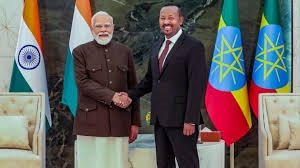
Arriving in Addis Ababa after concluding his visit to Jordan, Prime Minister Modi was accorded an unusually warm and personal reception by Ethiopian Prime Minister Abiy Ahmed Ali, setting the tone for a visit rooted as much in diplomacy as in personal rapport.
From the formal welcome at the National Palace to the informal airport interaction, and from traditional Ethiopian coffee diplomacy to a rare gesture of the host leader personally driving his guest to the hotel, the visit conveyed a clear message: India and Ethiopia are seeking a deeper, more human-centric partnership.


A First Visit with Strategic Weight
This is Prime Minister Modi’s first visit to Ethiopia, one of Africa’s most influential nations and the diplomatic nerve centre of the continent as the host country of the African Union (AU).
Ethiopia’s importance in India’s Africa calculus stems from several factors:
- It is Africa’s second-most populous country
- Addis Ababa hosts the African Union Commission
- It plays a key role in East African regional stability
- It is emerging as a manufacturing and services hub
Against this backdrop, Modi’s two-day state visit is being viewed by diplomatic observers as a strategic signal of India’s long-term Africa engagement, not limited to trade, but encompassing governance, development, and multilateral cooperation.
National Palace Talks: Respect, Equality, Partnership
At the National Palace, Prime Minister Abiy Ahmed Ali formally welcomed PM Modi before the two leaders commenced bilateral discussions.
During the meeting, Abiy Ahmed publicly acknowledged Modi’s consistent articulation of India’s Africa philosophy.
“Prime Minister Modi has always said that Africa’s partnerships should be shaped by Africa’s needs and priorities,”
the Ethiopian Prime Minister noted.
He further emphasized the necessity for a new and stronger India–Ethiopia partnership, grounded in:
- Mutual respect
- Equality
- Shared development goals
- Long-term cooperation
This framing aligns closely with India’s stated approach of development partnership rather than donor-recipient relationships, distinguishing New Delhi’s engagement model from extractive or influence-driven frameworks.
The Power of Personal Diplomacy
One of the most striking aspects of the visit was the personal diplomacy displayed by Prime Minister Abiy Ahmed.
Instead of delegating protocol duties, the Ethiopian leader:
- Personally received PM Modi at Addis Ababa airport
- Held informal discussions upon arrival
- Served traditional Ethiopian coffee, a powerful cultural symbol
- Drove PM Modi himself to the hotel
- Showed him landmarks such as the Science Museum and Friendship (Maitri) Park
In diplomatic terms, such gestures are rare and deliberate. They signal trust, warmth, and political comfort, often laying the groundwork for smoother negotiations and deeper alignment.

Diaspora Connect: People-to-People at the Core
Upon reaching the hotel, Prime Minister Modi was welcomed by members of the Indian diaspora, reflecting the enduring people-to-people ties between the two nations.
The Prime Minister:
- Interacted with community members
- Watched a cultural dance performance by a young child
- Acknowledged the diaspora’s contribution to bilateral relations
India’s engagement with Africa has increasingly emphasized diaspora diplomacy, recognizing overseas Indian communities as bridges of culture, commerce, and goodwill.
India–Ethiopia Relations: A Quietly Enduring Partnership
India and Ethiopia share a relationship that predates modern geopolitical competition in Africa.
Key pillars include:
- Development cooperation
- Capacity-building programmes
- Education and training
- Pharmaceuticals and healthcare
- Agriculture and engineering exports
Indian companies have long been present in Ethiopia, particularly in manufacturing, textiles, pharmaceuticals, and agriculture-related sectors.
This visit is expected to reinvigorate that partnership, aligning it with Ethiopia’s development priorities and India’s expanding global role.
Africa at the Centre of India’s Global Strategy
Prime Minister Modi’s Ethiopia visit must be seen in the larger context of India’s Africa strategy, which has gained momentum over the past decade.
Key features of this approach include:
- Equal partnerships rather than hierarchical aid models
- Emphasis on capacity building
- Support for African voices in global forums
- Cooperation through South-South frameworks
India has consistently advocated for greater African representation in global institutions, including multilateral bodies.
Addis Ababa: More Than a Capital
Choosing Ethiopia for such a high-profile visit is diplomatically significant.
Addis Ababa is:
- The headquarters of the African Union
- A hub for pan-African diplomacy
- A gateway to multilateral African engagement
Engagement with Ethiopia allows India to connect not only bilaterally but also with continental leadership, reinforcing its image as a partner of Africa as a whole.
Symbolism and Substance
While the visit featured strong symbolism, it is equally about substance.
Diplomatic engagements during the two-day visit are expected to focus on:
- Trade and investment facilitation
- Development cooperation
- Education and skill development
- Technology and innovation
- Multilateral coordination
The emphasis remains on long-term collaboration, not short-term announcements.
Why This Visit Matters Now
The timing of the visit is critical.
Africa is witnessing:
- Increased global competition for influence
- Rapid economic and demographic growth
- A search for development partners aligned with local priorities
India’s approach, articulated repeatedly by Prime Minister Modi, positions New Delhi as a partner that listens, rather than dictates.
A Visit That Sets the Tone
Prime Minister Modi’s first visit to Ethiopia is less about headlines and more about setting diplomatic tone.
It reinforces:
- India’s respect-based Africa engagement
- The importance of leadership-level trust
- The role of culture and people-to-people ties
- Ethiopia’s centrality in Africa diplomacy
As India seeks a larger role on the global stage, its engagement with Africa—anchored in visits such as this—will play an increasingly decisive role.

A Foundation for the Future
The Addis Ababa visit may be remembered not for dramatic announcements, but for the quiet confidence of a partnership built on equality.
Through personal gestures, principled dialogue, and strategic intent, Prime Minister Modi’s Ethiopia visit lays the groundwork for a future-oriented India–Africa relationship, one that seeks growth not through dominance, but through cooperation.
(Economy India)