
As major economies clash over disclosure norms, the debate reflects deeper fault lines between developed and developing nations
New Delhi (Economy India): The latest warning by India to members of the World Trade Organization against the “weaponisation” of transparency marks a critical moment in the ongoing debate over WTO reform.
At first glance, the issue appears technical—centred around disclosure norms under agreements such as the Technical Barriers to Trade (TBT). But beneath the surface, it reflects a deeper geopolitical struggle over power, fairness, and control in global trade governance.
As the United States pushes for stricter transparency rules, India’s response signals resistance from developing economies wary of asymmetrical obligations and potential misuse of rules.
This analysis explores the geopolitical, economic, and institutional implications of this emerging fault line.
Understanding ‘Transparency’ in WTO Framework
Transparency is a foundational principle of the WTO system.
Core Requirements:
- Notification of trade policies
- Disclosure of subsidies
- Reporting of regulatory changes
The idea is simple: transparency ensures predictability, reduces disputes, and builds trust.
However, in practice, compliance varies significantly across countries due to:
- Institutional capacity differences
- Administrative complexity
- Resource constraints
The US Push: Rules-Based Order or Strategic Leverage?
The United States has been at the forefront of advocating stricter transparency norms.
Key Demands:
- Mandatory and timely disclosures
- Penalties for non-compliance
- Stronger monitoring mechanisms
US Argument:
- Lack of transparency distorts global trade
- Hidden subsidies create unfair advantages
- Stronger rules are needed for a level playing field
Geopolitical Interpretation
While the US frames this as a rules-based reform, critics argue it may also serve strategic objectives:
- Increasing pressure on emerging economies
- Targeting state-led economic models
- Expanding influence over global trade norms
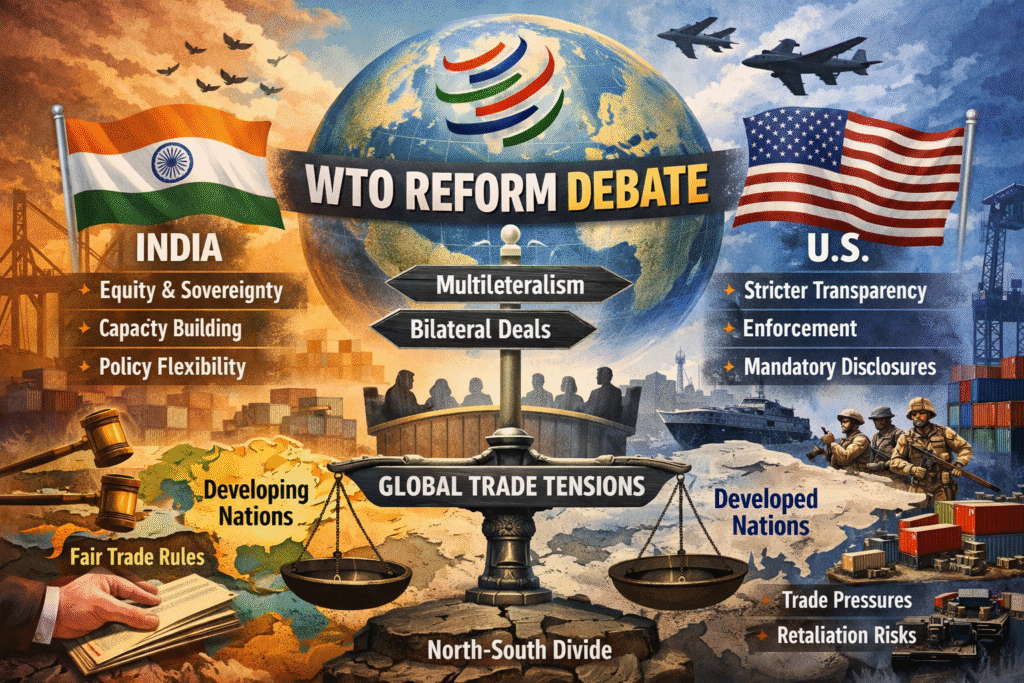
India’s Position: Equity, Sovereignty, and Development
India’s response reflects a broader coalition of developing countries.
Core Concerns:
1. Weaponisation of Transparency
India warns that transparency provisions could be used to:
- Justify retaliatory tariffs
- Challenge domestic policies
- Initiate disputes selectively
2. Unequal Capacity
Not all countries can:
- Maintain real-time reporting systems
- Meet complex notification requirements
This creates an uneven playing field.
3. Policy Sovereignty
India emphasizes the need to protect:
- Agricultural policies
- Industrial development strategies
- Welfare measures
The North–South Divide in Global Trade
The transparency debate highlights a long-standing divide:
Developed Countries
- Advocate stricter rules
- Emphasize compliance and enforcement
- Seek greater market openness
Developing Countries
- Stress flexibility and fairness
- Highlight capacity constraints
- Prioritize development goals
This divide has historically shaped WTO negotiations, from agriculture to intellectual property.
Transparency vs Development: A Structural Tension
At its core, the debate is about balancing two competing objectives:
Transparency
- Promotes accountability
- Reduces uncertainty
- Enhances trust
Development
- Requires policy flexibility
- Needs gradual integration
- Depends on state support
India’s position seeks to reconcile these objectives by advocating:
- Fair implementation
- Capacity-building support
- Context-sensitive rules
The disagreement over transparency has broader implications.
Slower Reform Process
Diverging priorities may:
- Delay consensus
- Stall negotiations
- Prolong institutional paralysis
Fragmentation of Trade System
If consensus fails:
- Countries may turn to bilateral agreements
- Regional trade blocs may gain prominence
Rise in Trade Disputes
Stricter rules without consensus could:
- Increase disputes
- Escalate tensions
Strategic Stakes for India
India’s stance is not merely defensive—it is strategic.
Leadership Among Developing Nations
India positions itself as:
- A voice for the Global South
- A defender of equitable trade rules
Protecting Domestic Economy
Key sectors at stake:
- Agriculture
- MSMEs
- Public welfare programs
Balancing Global Integration
India seeks:
- Integration into global markets
- Without compromising domestic priorities
The Role of Multilateralism in a Changing World
The WTO is facing an existential challenge.
- Weak dispute settlement system
- Rising protectionism
- Shift toward bilateralism
India’s stance underscores the need to:
- Revitalize multilateralism
- Ensure inclusivity
- Build trust among members
Strict Enforcement Model
- Led by developed countries
- Higher compliance pressure
Flexible Framework
- Incorporates capacity-building
- Allows phased implementation
Hybrid Approach
- Combines enforcement with support
- Most likely outcome
The transparency debate is not just about technical rules—it is about who sets the rules of global trade.
India’s intervention highlights a critical principle:
👉 Fair rules must account for unequal capabilities
Without this, transparency risks becoming:
- A tool of enforcement
- Rather than a mechanism of cooperation
- Intensified debates within WTO
- Divergence between US and developing nations
Medium-Term
- Gradual reforms with compromises
- Increased role of regional trade agreements
- Redefinition of global trade governance
- Greater influence of emerging economies like India
India’s warning against the “weaponisation” of transparency marks a defining moment in WTO reform debates.
As global trade evolves, the challenge will be to design a system that is:
- Transparent
- Fair
- Inclusive
The future of the WTO—and the broader multilateral trading system—will depend on how effectively it balances these competing priorities.
In this context, India’s stance is not just a reaction—it is a vision for a more equitable global trade order.
(Economy India)