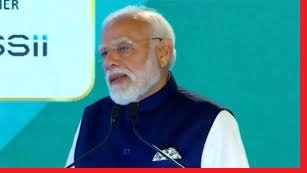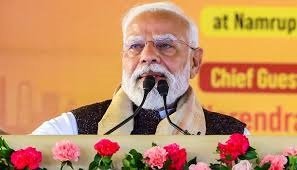

New Delhi (Economy India): Prime Minister Narendra Modi has asserted that the Union Budget for the coming fiscal year represents a decisive shift away from short-term populism and toward long-term capital formation, with record public investment aimed at creating jobs, strengthening infrastructure, and sustaining high economic growth.
In an exclusive interview with Press Trust of India, the Prime Minister said productive spending has been the defining hallmark of his government, and the latest Budget reflects a conscious strategy to invest in future economic capacity rather than transient consumption-driven measures.
“This Budget represents the next level in our reform journey. It imparts momentum to our Reform Express and prepares our youth for opportunities in a rapidly changing global economy,” Modi said, describing the document as a clear reflection of his government’s governance style and priorities.
A Deliberate Shift Away from Populism
According to the Prime Minister, the Budget consciously avoids short-term populist announcements that may offer immediate political dividends but fail to create lasting economic value. Instead, it focuses on asset creation, productivity enhancement, and structural reforms that strengthen the economy over time.
“Productive spending has been the hallmark of our government,” Modi said, adding that high-quality capital expenditure is essential for long-term growth, employment generation, and competitiveness.
The Budget, he said, reflects a belief that sustainable improvements in living standards come not from temporary handouts but from investments that create jobs, raise incomes, and expand economic opportunities.
Record Capital Expenditure Anchors Growth Strategy
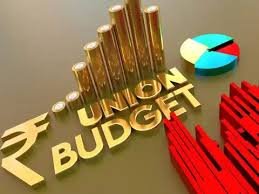
The FY27 Union Budget sharply increases capital expenditure to ₹12.2 lakh crore, nearly five times higher than the level in 2013, underlining the government’s reliance on public investment as the primary engine of growth.
This capex push is aimed at:
- Strengthening core infrastructure
- Crowding in private investment
- Improving logistics efficiency
- Enhancing India’s productive capacity
Modi said the government has consistently used public capital expenditure to trigger a virtuous cycle of growth, in which improved infrastructure lowers costs for businesses, boosts competitiveness, and generates employment across sectors.
“High capital investment is a strong engine for long-term growth. It creates assets that serve the economy for decades,” he said.
Economic Survey Signals Higher Growth Potential
Citing the pre-Budget Economic Survey, the Prime Minister noted that India’s potential growth rate has risen to around 7 per cent, supported by three major pillars—capital accumulation, labour formalisation, and digital public infrastructure.
Over the past decade, the government has expanded digital platforms, formalised millions of workers through financial inclusion and social security schemes, and invested heavily in physical infrastructure. Together, these efforts have improved productivity and strengthened macroeconomic fundamentals.
Modi emphasised that growth must be accompanied by macroeconomic stability, low inflation, and fiscal discipline—principles that continue to guide the government’s economic policy.
Infrastructure at the Centre of the ‘Viksit Bharat’ Vision
The Prime Minister acknowledged that for decades, inadequate and outdated infrastructure had constrained India’s development and imposed high costs on citizens and businesses alike.
“Broken and outdated infrastructure has no place in a nation that aspires to become a Viksit Bharat,” he said.
Over the last ten years, India has witnessed what Modi described as the most expansive infrastructure-building effort in its history. This has included both the creation of new assets and the modernisation of existing infrastructure, with an emphasis on quality, durability, and future readiness.
Key areas of progress include:
- Doubling of the number of airports
- Expansion of metro rail services to over four times the number of cities compared to a decade ago
- Rapid growth in rural road networks
- Significant improvement in broadband and internet connectivity
Large-scale investments have also been made in ports, coastal infrastructure, and freight corridors to strengthen India’s logistics backbone and integrate domestic supply chains with global trade routes.
Railways Receive Major Boost
Indian Railways has been allocated nearly ₹3 lakh crore in capital outlay, underscoring its central role in the government’s infrastructure strategy.
According to Modi, the focus areas include:
- High-speed passenger connectivity
- Expansion of freight capacity
- Improved passenger safety and modernisation
Seven new high-speed rail corridors have been proposed to connect major cities, including the South High-Speed Diamond Corridor, which is expected to benefit Karnataka, Telangana, Andhra Pradesh, Tamil Nadu, Kerala, and Puducherry.
In addition, the expansion of Dedicated Freight Corridors is aimed at decongesting passenger routes, reducing logistics costs for industry, and improving supply chain efficiency.
National Highways and Logistics Expansion
Allocations for national highways have increased nearly 500 per cent compared to a decade ago, reflecting the government’s focus on improving road connectivity and reducing travel time and transportation costs.
Improved highways, combined with investments in ports and freight corridors, are expected to enhance India’s logistics efficiency, which has long been a concern for manufacturers and exporters.
Modi said better logistics infrastructure directly contributes to job creation by stimulating construction activity, attracting private investment, and supporting industrial growth across regions.
Focus on Sunrise Sectors and Future Industries
Beyond traditional infrastructure, the Budget places strong emphasis on emerging and sunrise sectors that are expected to drive future growth and employment.
According to the Prime Minister, targeted investments are being made in:
- Semiconductors and electronics component manufacturing
- Biopharmaceuticals and healthcare innovation
- Rare earth corridors and critical minerals
- Chemical parks and advanced manufacturing clusters
“These sectors will provide a new impetus to jobs and investment while strengthening India’s future economic resilience,” Modi said.
The government’s strategy is to position India as a global manufacturing and innovation hub, reducing import dependence and integrating domestic industry into global value chains.
Trust-Based Governance and Compliance Reforms
A key feature of the Budget, Modi said, is its emphasis on governance reforms that go beyond fiscal numbers.
“Across sectors and ministries, we are reducing paperwork, decriminalising offences, and simplifying compliance requirements,” he said.
The Prime Minister stressed that trust-based governance is central to the government’s philosophy, with the state acting as an enabler rather than a controller.
He argued that such reforms will have a deeper and more lasting impact on citizens and businesses than headline budgetary allocations, by reducing friction, lowering compliance costs, and encouraging entrepreneurship.
Inclusive and Technology-Driven Welfare Architecture
Modi said his government has built an inclusive, technology-driven welfare architecture that ensures benefits reach the last mile while minimising leakages.
Digital platforms, direct benefit transfers, and integrated databases have helped deliver welfare efficiently, he said, while maintaining fiscal discipline.
According to the Prime Minister, economic strengthening and nation-building remain the guiding principles behind welfare policies, ensuring that growth and social inclusion move together.
India’s Position in a Changing Global Order
Framing the Budget in the context of global economic shifts, Modi said the post-pandemic world order is opening new opportunities for India.
“We are seeing countries eager to partner with India in trade and innovation. We have a young and increasingly skilled population, and we are focused on strong growth with low inflation and macroeconomic stability,” he said.
The Budget, he added, is designed to help India capitalise on these global trends by strengthening domestic capabilities and enhancing competitiveness.
Budget for the Next Quarter-Century
The Prime Minister urged that the Budget should not be viewed merely as an annual financial statement.
“This is the first Budget of the second quarter of the 21st century. It consolidates the gains made since 2014 and builds momentum for the next 25 years,” he said.
Drawing a historical parallel, Modi noted that decisions taken in the early 20th century laid the foundation for India’s independence in 1947.
“Similarly, the decisions we are taking today are laying the foundation for a Viksit Bharat by 2047,” he said.
Economy India Analysis
The Union Budget reinforces India’s capex-led growth model, signalling policy continuity, fiscal prudence, and a long-term development vision. By prioritising infrastructure, sunrise sectors, and governance reforms over short-term populism, the government is betting that sustained investment and structural change will deliver durable growth and employment in the years ahead.
For investors, industry, and states alike, the message is clear: India’s economic strategy remains anchored in long-term productivity, infrastructure creation, and institutional reform.
(Economy India)