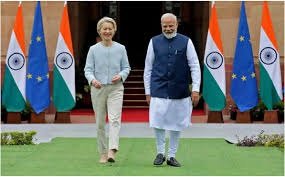
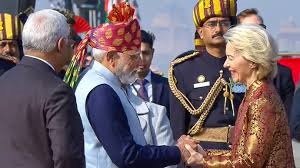
New Delhi (Economy India): When European Commission President Ursula von der Leyen said that “a successful India makes the world more stable, prosperous and secure” after witnessing India’s 77th Republic Day celebrations at Kartavya Path, it was more than ceremonial diplomacy. It was a carefully worded geopolitical signal at a time when global power equations are undergoing rapid realignment.
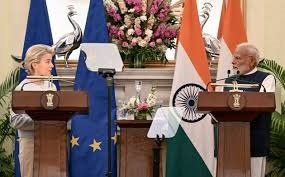
Her presence in New Delhi—alongside European Council President Antonio Costa—as chief guest at India’s most important national ceremony, just a day ahead of the India-EU Summit, underlined the strategic depth and urgency of the partnership between the world’s largest democracy and the European Union.
In an era marked by trade wars, military conflicts, supply-chain disruptions and political uncertainty in the West, India has emerged as a central pillar of global stability—economically, politically and strategically. For Europe, increasingly caught between the United States’ transactional policies, China’s assertive rise and Russia’s prolonged conflict with Ukraine, India represents not just a partner, but a balancing force.
Republic Day Diplomacy: Symbolism with Strategic Meaning
India’s Republic Day parade has long been a platform for projecting national power, unity and intent. The presence of top EU leadership at Kartavya Path was deeply symbolic.
Over the decades, India has invited global leaders selectively—often signaling foreign policy priorities. From French presidents to US leaders and Asian allies, Republic Day chief guests have mirrored India’s evolving diplomatic focus.
Inviting EU leadership at this moment reflects three strategic realities:
- Europe sees India as a long-term economic and security partner
- India is positioning itself as a central player in a multipolar world
- Both sides seek greater autonomy from dominant global blocs
Von der Leyen’s words resonated because they acknowledged India’s growing role not merely as a regional power, but as a global stabiliser.
India-EU Relations: From Trade to Strategic Convergence
India and the European Union share one of the world’s largest economic relationships.
- The EU is India’s largest trading partner
- Bilateral trade in goods and services exceeds €120 billion annually
- European companies are among the largest investors in India
Yet, for years, the relationship remained under-leveraged due to stalled trade negotiations, regulatory differences and differing strategic priorities.
That is changing rapidly.
Revival of the India-EU Free Trade Agreement
After nearly a decade of stagnation, negotiations on the India-EU Free Trade Agreement (FTA) have gained fresh momentum.
The renewed push reflects:
- Europe’s desire to reduce dependency on China
- India’s ambition to become a global manufacturing hub
- Shared concerns over supply-chain resilience
Key sectors under negotiation include:
- Automobiles and electric vehicles
- Pharmaceuticals
- Green energy technologies
- Digital trade and data governance
- Agriculture and food processing
While challenges remain—especially around market access and regulatory standards—both sides now see the FTA as a strategic necessity rather than a commercial option.
Why Europe Needs India More Than Ever
Europe today faces a complex set of pressures:
1. Russia-Ukraine War and Energy Insecurity
The prolonged Ukraine conflict has reshaped Europe’s security and energy policies. Dependence on Russian gas has forced European economies into painful transitions, pushing inflation higher and slowing growth.
India’s role here is subtle but significant:
- India has maintained strategic autonomy in global conflicts
- It has continued engagement with all major powers
- Its stable economic growth offers Europe a reliable external partner
2. Strategic Fatigue with the US
While transatlantic ties remain strong, Europe is increasingly uncomfortable with:
- US tariff threats
- Unpredictable foreign policy shifts
- Domestic political polarisation in Washington
India, by contrast, offers predictability, continuity and long-term planning.
3. China Risk and Supply Chain Diversification
European businesses are actively looking to de-risk from China.
India stands out due to:
- Large domestic market
- Democratic governance
- Skilled workforce
- Expanding manufacturing ecosystem under Make in India and PLI schemes
Von der Leyen’s statement reflects this recalibration.
India as a Pillar of Global Stability
India’s appeal to Europe lies in its unique position in the global order.
A Stable Democracy in an Unstable World
At a time when democracies worldwide are under stress, India has demonstrated:
- Institutional continuity
- Electoral legitimacy
- Policy stability despite political competition
For Europe, which defines itself as a normative power, partnering with India reinforces its democratic identity.
Economic Growth Engine
India remains one of the fastest-growing major economies.
- Strong domestic consumption
- Expanding digital economy
- Infrastructure investment
- Startup and innovation ecosystem
A growing India contributes to global demand, benefiting European exporters and investors.
Strategic Autonomy and Balanced Diplomacy
India’s ability to maintain relations with:
- The US
- Europe
- Russia
- Global South
…without formal military alliances makes it a rare stabilising force in an increasingly fragmented world.
Indo-Pacific, Security and Shared Interests
Beyond economics, India-EU cooperation is expanding into security domains.
Indo-Pacific Strategy
Both India and the EU see the Indo-Pacific as central to future global stability.
Areas of cooperation include:
- Maritime security
- Freedom of navigation
- Cybersecurity
- Counter-terrorism
The EU’s Indo-Pacific strategy aligns closely with India’s vision of a free, open and inclusive region.
Defence and Strategic Technology
Europe is increasingly open to:
- Defence manufacturing partnerships
- Joint research in aerospace and cyber defence
- Cooperation on critical technologies
India’s growing defence indigenisation drive presents new opportunities for European firms.
Climate, Green Transition and Sustainability
Climate change is another pillar of the India-EU relationship.
While Europe pushes aggressive climate targets, it recognises that India’s development needs require flexibility and cooperation, not pressure.
Key collaboration areas:
- Green hydrogen
- Renewable energy financing
- Electric mobility
- Climate-resilient infrastructure
India’s scale makes it indispensable to any meaningful global climate solution.
The Political Message Behind Von der Leyen’s Words
When Ursula von der Leyen said a “successful India makes the world more stable”, she was also sending a message to multiple audiences:
- To global markets: India is a safe, long-term bet
- To China: Europe has alternatives
- To the US: Europe is diversifying strategic partnerships
- To the Global South: India is a bridge between developed and developing worlds
Her statement acknowledged India’s rising influence without framing it as a challenge to any power—reflecting India’s own diplomatic style.
Challenges Ahead: Not a Perfect Partnership
Despite the optimism, challenges remain.
- Trade negotiations are complex and politically sensitive
- Regulatory alignment takes time
- Differences persist on data protection and carbon policies
However, unlike earlier phases, both sides now approach these challenges with strategic patience rather than frustration.
A Partnership Shaping the 21st Century
The sight of European leaders at Kartavya Path, watching India showcase its cultural diversity, economic ambition and military capability, captured a deeper truth of contemporary geopolitics.
India is no longer just a rising power—it is a stabilising force in a fractured world.
For Europe, engaging India is not optional; it is essential.
As India and the EU prepare for the next phase of their relationship—through trade deals, security cooperation and shared global responsibilities—the message from New Delhi is clear:
A confident, successful India does not destabilise the world. It steadies it.
(Economy India)