
New Delhi (Economy India): India’s media and advertising ecosystem is entering a critical phase of transformation with the introduction of the TV Ratings Policy 2026 by the Ministry of Information and Broadcasting. The new policy, which replaces the 2014 guidelines, seeks to overhaul the framework governing television audience measurement by emphasizing transparency, independence, and accountability.
At a time when media consumption patterns are rapidly evolving due to digital disruption, the policy marks a decisive intervention to restore credibility in TV ratings—an essential pillar of India’s ₹90,000+ crore advertising economy.
This 2500-word analysis examines the structural context, economic implications, industry challenges, and future outlook of the TV Ratings Policy 2026.

The Context: Why TV Ratings Matter More Than Ever
Television ratings are the backbone of the media industry. They determine:

- Advertising rates
- Content programming strategies
- Channel positioning and competition
In India, where television continues to command a significant share of advertising spend despite the rise of digital platforms, accurate audience measurement remains critical.
However, the credibility of ratings has been questioned in recent years due to:
- Allegations of manipulation
- Lack of transparency in methodology
- Limited competition among rating agencies
The TV Ratings Policy 2026 aims to address these concerns and rebuild trust in the system.
Key Features of the TV Ratings Policy 2026
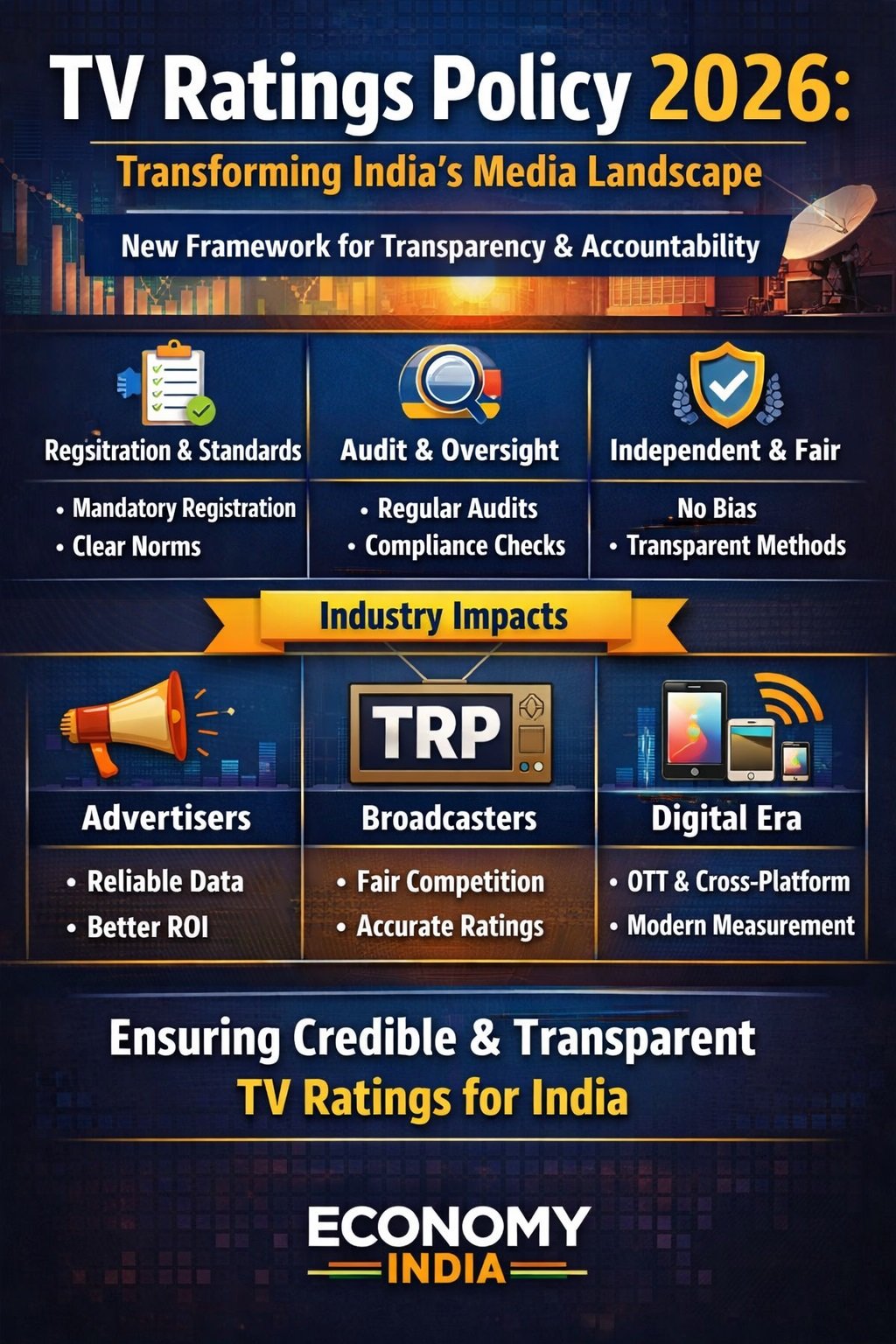
The new framework introduced by the Ministry of Information and Broadcasting establishes a comprehensive regulatory structure.
Registration and Eligibility Norms
The policy mandates:
- Mandatory registration for rating agencies
- Defined eligibility criteria
- Compliance with operational standards
This ensures that only credible and qualified entities operate in the market.
2.2 Operational Transparency
One of the most critical aspects of the policy is its focus on transparency.
Key Requirements:
- Disclosure of methodologies
- Clear data collection processes
- Standardized measurement techniques
This aims to eliminate opacity and enhance stakeholder confidence.
Audit and Oversight Mechanisms
The policy introduces strict audit requirements:
- Regular third-party audits
- Compliance checks
- Monitoring by regulatory authorities
This will ensure that rating agencies remain accountable for their operations.
Independence and Governance
To prevent conflicts of interest, the policy emphasizes:
- Independent functioning of rating agencies
- Clear governance structures
- Separation from broadcaster influence
Structural Challenges in India’s TV Ratings Ecosystem
Before assessing the impact of the new policy, it is essential to understand the existing challenges.
Limited Competition
India’s TV ratings market has historically been dominated by a single major player, leading to:
- Lack of competitive benchmarking
- Limited innovation
- High dependence on one data source
Sample Size and Representation Issues
Accurate ratings require a representative sample of households.
Challenges include:
- Urban-rural imbalance
- Underrepresentation of diverse demographics
- Limited penetration in smaller towns
Technological Constraints
Traditional rating systems rely on:
- Set-top box data
- Panel-based measurement
These methods may not fully capture:
- Multi-screen viewing
- OTT consumption
- Mobile-based content
Trust Deficit
Repeated controversies have led to:
- Skepticism among advertisers
- Credibility issues for broadcasters
- Demand for reform

Economic Implications for the Media and Advertising Industry
The TV Ratings Policy 2026 has significant economic implications.
Impact on Advertising Revenue
Advertising decisions are heavily dependent on ratings.
With Improved Transparency:
- Advertisers can allocate budgets more efficiently
- ROI measurement becomes more accurate
- Market distortions reduce
Impact on Broadcasters
Broadcasters will experience both opportunities and challenges.
Positive Effects:
- Fair competition
- Better alignment with audience preferences
Challenges:
- Increased scrutiny
- Need for content quality improvement
Impact on Rating Agencies
The new policy raises the bar for rating agencies.
Key Changes:
- Higher compliance costs
- Need for technological upgrades
- Increased accountability
Impact on Investors
For investors, the policy enhances:
- Market transparency
- Predictability of revenue streams
- Confidence in media valuations
Digital Disruption and the Need for Integrated Measurement
One of the biggest challenges facing the TV ratings ecosystem is the rise of digital platforms.
Changing Consumption Patterns
Viewers are increasingly consuming content on:
- Smartphones
- OTT platforms
- Connected TVs
This has fragmented audience measurement.
Need for Cross-Platform Measurement
The future of audience measurement lies in integration.
Key Requirements:
- Unified measurement across TV and digital
- Real-time data analytics
- AI-driven insights
The TV Ratings Policy 2026 is a step toward modernization, but further reforms may be needed to fully integrate digital metrics.
Global Best Practices and India’s Alignment
Globally, audience measurement systems are evolving rapidly.
Key Trends:
- Hybrid measurement models
- Use of big data and analytics
- Increased regulatory oversight
India’s new policy aligns with these trends by:
- Emphasizing transparency
- Strengthening governance
- Encouraging accountability
Policy Impact on Content Ecosystem
The policy could reshape content strategies across the industry.
Shift Toward Quality Content
Accurate ratings will:
- Reward high-quality programming
- Reduce reliance on manipulation
- Encourage innovation
Regional Content Growth
Improved measurement can:
- Highlight regional viewership patterns
- Boost regional content production
Niche Programming
Better data can support:
- Targeted content
- Audience segmentation
- Personalized programming
Risks and Implementation Challenges
While the policy is comprehensive, implementation will be key.
Compliance Burden
Smaller agencies may struggle with:
- High compliance costs
- Technological requirements
Data Privacy Concerns
With increased data collection:
Transition Challenges
Shifting from the old framework to the new policy may:
- Disrupt existing systems
- Require industry-wide adaptation
Long-Term Industry Transformation
The TV Ratings Policy 2026 has the potential to drive long-term transformation.
Formalization of the Sector
The policy will:
- Standardize practices
- Reduce irregularities
- Enhance governance
Increased Competition
Clear guidelines may:
- Encourage new entrants
- Foster innovation
- Improve service quality
Integration with Digital Ecosystem
Future developments may include:
- Cross-platform ratings
- Integration with OTT metrics
- Advanced analytics
Economy India Insight
The introduction of the TV Ratings Policy 2026 marks a pivotal moment for India’s media industry.
It reflects a broader shift toward:
- Institutional credibility
- Data-driven decision-making
- Transparent market practices
As advertising spending continues to grow, the importance of reliable audience measurement cannot be overstated.
Future Outlook
Short-Term Outlook
- Industry adaptation to new norms
- Increased scrutiny of rating agencies
- Transitional challenges
Medium-Term Outlook:
- Improved credibility of ratings
- Better alignment between content and audience preferences
- Stabilization of advertising markets
Long-Term Outlook
- Integrated TV-digital measurement systems
- Stronger regulatory ecosystem
- Sustainable growth in media and advertising
The TV Ratings Policy 2026 is more than a regulatory update—it is a structural reform aimed at redefining the foundations of India’s media ecosystem.
By focusing on transparency, accountability, and standardization, the Ministry of Information and Broadcasting has taken a decisive step toward restoring trust in audience measurement.
For broadcasters, advertisers, and investors, the policy offers an opportunity to build a more transparent, efficient, and growth-oriented media landscape.
The success of this reform, however, will depend on effective implementation, industry cooperation, and continuous adaptation to technological change.
(Economy India)