New Delhi (Economy India): In a significant intervention with far-reaching implications for India’s higher education system, the Supreme Court on Thursday stayed the implementation of the University Grants Commission’s (UGC) new equity regulations, citing concerns over ambiguity, scope for misuse, and potential social fragmentation on university campuses.
The apex court also directed the Union government and the UGC to redraft the regulations, underscoring the need for clarity, constitutional balance, and inclusiveness. Until further orders, the 2012 UGC regulations will continue to remain in force nationwide.
The matter will be taken up next on March 19.
What Are the UGC’s New Rules?
The regulations in question—officially titled “Promotion of Equity in Higher Education Institutions Regulations, 2026”—were notified by the UGC on January 13. Their stated objective was to prevent caste-based discrimination against Scheduled Caste (SC), Scheduled Tribe (ST), and Other Backward Classes (OBC) students in colleges and universities.

Key provisions included:
- Mandatory Equity Promotion Committees in institutions
- Dedicated helplines and monitoring cells
- Institutional accountability mechanisms for complaints
- A defined framework to identify and act on “caste-based discrimination”
The government argued that the rules aimed to strengthen fairness, dignity, and grievance redressal in higher education.
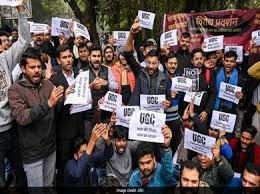
However, soon after notification, the regulations triggered widespread opposition across states, particularly from sections of students and faculty who alleged that the framework was selective, exclusionary, and prone to misuse.
Supreme Court’s Core Objections
A bench comprising Chief Justice of India Justice Suryakant and Justice Joymalya Bagchi made it clear that the court was not questioning the intent of social justice, but the method and legal architecture adopted.
The bench noted that the regulations, in their current form, raised serious constitutional and administrative concerns.
1. Ambiguity in Defining Discrimination
The court questioned why the regulations created a separate, narrow definition of “caste-based discrimination” when Indian law already recognizes a broad, inclusive definition of discrimination.
“If discrimination as a concept already covers all forms—social, economic, regional, linguistic—why carve out a separate definition that applies only to one category?” the court asked.
The judges expressed concern that such selective definitions could distort the principle of equality before law.
2. Absence of Ragging in the Framework
One of the bench’s strongest criticisms was the complete exclusion of ragging from the new regulations.
Calling ragging a serious and persistent campus problem, the court questioned how a regulation aimed at student protection could ignore it altogether.
“Ragging is often the first form of harassment a student faces. Why has it been excluded?” the CJI asked during the hearing.
Lawyers argued that under the new framework, ragging incidents could be mislabelled as caste-based discrimination, exposing students to criminal liability even in ambiguous cases.
3. Fear of Presumption of Guilt
Petitioners argued—and the court appeared receptive to the concern—that the regulations risked treating students from general categories as ‘presumptive offenders’.
Senior advocates contended that the structure of complaints and committees implicitly assumed culpability, thereby violating principles of natural justice.
“Equality cannot mean replacing one form of discrimination with another,” one counsel argued.
4. Social Fragmentation on Campuses
The bench strongly objected to proposals such as separate hostels or facilities based on caste identity, warning that such measures could reverse decades of social integration.
In one of the most striking observations, the CJI remarked:
“For God’s sake, don’t do this. We lived together. Inter-caste marriages happen today. Educational institutions must reflect India’s unity.”
The court questioned whether such measures aligned with the constitutional goal of a casteless, integrated society.
Courtroom Highlights: A Constitutional Debate
The hearing reflected a broader debate about social justice versus social cohesion.
- Lawyers challenging the rules argued that Rule 3(C)—which defines caste-based discrimination—was overly restrictive and exclusionary.
- The court raised hypothetical scenarios, such as regional discrimination faced by students from the Northeast or South India, asking whether the regulations addressed such realities.
- The bench also asked whether reverse discrimination—if perpetrated by students from reserved categories—would be addressed under the framework.
The UGC, while defending the intent of the rules, acknowledged that drafting improvements could be considered.
Interim Order: What the Court Decided
The Supreme Court:
- Stayed the operation of the 2026 UGC regulations
- Directed the Centre and UGC to file detailed responses
- Asked authorities to prepare a fresh, clearer draft
- Ordered that UGC’s 2012 regulations will remain applicable
- Fixed March 19 as the next date of hearing
Crucially, the court clarified that it was examining the matter only on constitutional and legal grounds, not questioning the need to protect vulnerable students.
Nationwide Reactions: Relief, Celebration, and Counter-Protests
The stay order triggered sharp and contrasting reactions across states.
Uttar Pradesh
- In Varanasi, students celebrated by throwing colours and distributing sweets.
- In Bareilly, protests turned political, with slogans raised against officials who supported the regulations.
- A resigned city magistrate described the rules as a “black law” for sections of society, triggering further controversy.
Other States
Student bodies, teachers’ associations, and civil society groups across India welcomed the stay but called for a more inclusive, consultative drafting process.
At the same time, organisations representing SC/ST students expressed concern that the pause could delay institutional accountability against genuine discrimination.
The Larger Question: How Should Equity Be Implemented?
The Supreme Court’s intervention brings into focus a larger policy dilemma:
- How can institutions protect marginalised students without
- Creating new social fault lines, and
- Without undermining due process and equality before law?
Experts note that India’s higher education ecosystem already operates under multiple frameworks addressing discrimination, harassment, and ragging.
The challenge lies in harmonising these mechanisms, not fragmenting them.
Why This Verdict Matters Beyond Campuses
1. Constitutional Precedent
The ruling reinforces the idea that social justice measures must pass constitutional tests of fairness, clarity, and proportionality.
2. Policy Drafting Standards
It sends a strong signal to regulators that well-intentioned policies must be legally precise and socially balanced.
3. Campus Governance
Universities are reminded that grievance redressal systems must be inclusive, neutral, and transparent.
4. Social Discourse
At a time of heightened identity debates, the verdict underscores the judiciary’s role in preventing institutionalised division.
What Happens Next?
The ball is now in the government’s court.
The Supreme Court hinted at the possibility of forming an expert committee comprising sociologists, legal scholars, and educationists to draft a more balanced framework.
Any revised regulation will likely need to:
- Adopt broad, inclusive definitions of discrimination
- Integrate ragging and other forms of harassment
- Ensure procedural safeguards for all students
- Avoid structural segregation based on identity
A Pause, Not a Rejection
The Supreme Court’s stay is not a rejection of equity, but a demand for better policy craftsmanship.
As India expands its higher education footprint and as campuses become more diverse, the need for fair, constitutionally sound protections is undeniable. Equally important is ensuring that such protections unite rather than divide.
The coming months will determine whether India can craft a regulatory framework that balances dignity with unity, justice with fairness, and protection with harmony.
(Economy India)