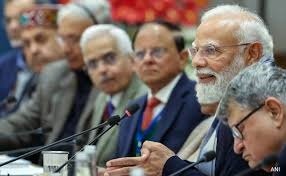

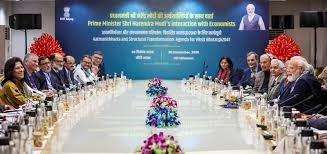
New Delhi (Economy India): Prime Minister Narendra Modi on Tuesday held a strategic consultation with the country’s leading economists, policy researchers, and sectoral experts at NITI Aayog ahead of the upcoming Union Budget 2026-27. The meeting aimed at shaping India’s long-term economic roadmap with a focus on self-reliance (Aatmanirbharta), structural transformation, and sustainable growth.
Finance Minister Nirmala Sitharaman, NITI Aayog Vice Chairperson Suman Bery, CEO BVR Subrahmanyam, and senior members of the commission were present during the high-level interaction.
Agenda: Aatmanirbharta & “Viksit Bharat 2047”
Officials said the central theme of the meeting was:
“Aatmanirbharta and Structural Transformation: Agenda for Viksit Bharat.”
The consultations focused on how India can accelerate reforms to achieve developed nation status by 2047, building global competitiveness, strengthening supply chains, and improving productivity across sectors.
“India’s next leap depends on world-class capability and global market integration. Reforms now will define the next 25 years,” one participant said after the meeting.
Key Policy Areas Discussed
During the three-hour session that began at 11 AM, a wide range of macro and sectoral themes were analysed, including:
🔹 Growth Drivers & Next-Generation Reforms
- Reducing economic bottlenecks and regulatory friction
- Enhancing industrial competitiveness
- Policy push for high-value manufacturing and deep tech innovation
🔹 Domestic Consumption & Market Expansion
- Strengthening rural and urban demand engines
- Improving logistics and lowering consumer inflationary pressure
🔹 Trade, Tariffs & Export Strategy
- Reviewing tariff structures to boost export competitiveness
- Ensuring India’s deeper integration into global value chains
🔹 Employment, MSME Revival & Investment Climate
- Job creation through MSME & manufacturing incentives
- Capital inflows and private sector participation in infrastructure
Who Attended
Senior leadership of NITI Aayog and key stakeholders from multiple sectors, including banking, MSMEs, manufacturing, tech, services, and financial markets, were present. The meeting forms part of the government’s pre-budget consultation cycle, which also includes dialogues with:
- Industry bodies
- Trade unions & labour groups
- Startups & innovation associations
- Public input via MyGov platform
Budget 2026-27: What to Expect
Finance Minister Nirmala Sitharaman will present the Union Budget on February 1, 2026. Sources suggest that the upcoming budget will blend stability + reform, keeping in mind global uncertainties, Middle East energy risk, currency volatility, and supply chain disruptions.
Possible policy directions include:
- Targeted support for employment-intensive sectors
- Incentives for advanced manufacturing, semiconductors, EVs, green energy
- Rationalising customs duties for export competitiveness
- Strengthening financial markets & capital access
- Boost for services sector: tourism, logistics, IT, and digital trade
Long-Term Impact: Road to 2047
Experts believe the consultations will significantly influence reform blueprints not only for this year but for India’s 25-year transformation plan.
“The consultation signals a shift from short-term budgeting to long-term economic architecture. India is planning with a 20–25 year horizon,” an economist attending the meeting said.
The government is expected to prioritise:
- Macro-economic stability
- Investment-led growth
- Resilient supply chains
- Human capital & skill development
- Innovation ecosystems
The NITI Aayog meeting marks a crucial step in aligning expert opinion, government priorities, and national development vision. With the budget scheduled in just a few weeks, the recommendations discussed are expected to form the backbone of India’s upcoming policy direction.
As India positions itself for the next phase of growth, the meeting reflects a strategic transition from economic recovery to long-term structural acceleration, aiming to create a globally competitive and self-reliant Viksit Bharat by 2047.
(Economy India)