More Indians than ever before are earning ₹10 lakh+ annually — a powerful sign of growing prosperity.
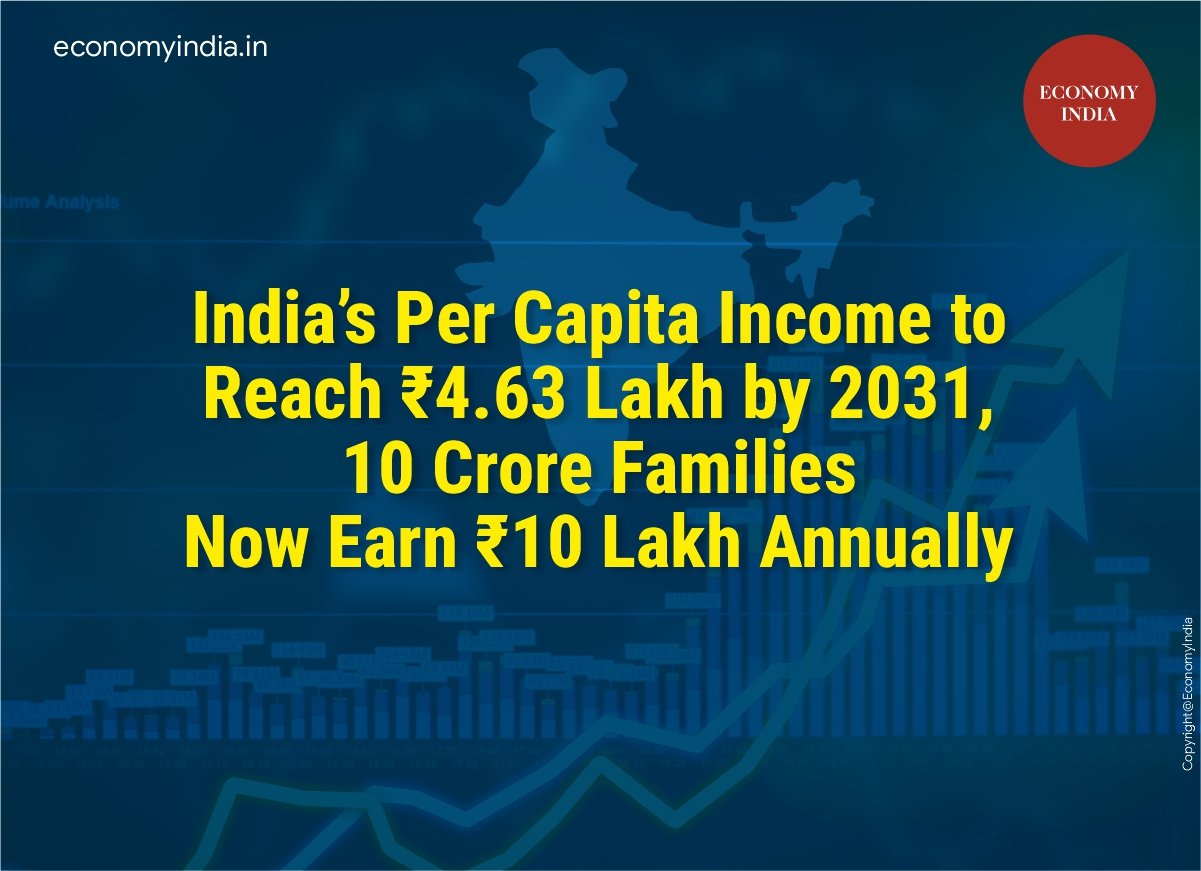
Mumbai | Economy India News Bureau | India’s economy is undergoing a remarkable transformation — one driven not merely by infrastructure and industry, but by rising incomes, urban aspirations, and consumer confidence. According to a comprehensive study released by global asset management giant Franklin Templeton, India’s per capita income has doubled between 2010 and 2024, reaching ₹2.41 lakh per year, and is expected to nearly double again to ₹4.63 lakh by 2031.
The report projects that India’s nominal GDP will continue its rapid growth trajectory, expanding at a compound annual growth rate (CAGR) of 11% between 2024 and 2030 to reach a massive ₹644 lakh crore.
At the core of this transformation lies India’s expanding middle-income population, a segment that now forms the backbone of national consumption and economic expansion.

A Decade of Income Growth and Rising Prosperity
Franklin Templeton’s analysis reveals that the number of Indian households earning ₹10 lakh or more annually has grown from 6 crore in 2013 to 10 crore in 2024 — a staggering 67% increase in just over a decade.
This shift represents a significant expansion of India’s consuming class, with these higher-income families accounting for nearly 40% of total national consumption. Such demographic shifts are reshaping spending patterns across urban and semi-urban India.
From cars and homes to branded consumer goods, travel, and digital services — India’s consumers are demonstrating stronger purchasing power than ever before.
From Necessity to Aspiration: A Changing Consumption Landscape
The report emphasizes that India is steadily evolving from a necessity-driven economy to an aspiration-driven one. While earlier generations prioritized basic needs, today’s consumers are driven by a desire for quality, comfort, and experience.
Rising disposable incomes are prompting households to spend more on:
- Premium lifestyle products such as electronics, branded apparel, and luxury accessories.
- Healthcare and wellness, as awareness and affordability rise.
- Travel and leisure, both domestic and international.
- Education and skill development, particularly in the digital economy.
Franklin Templeton notes that this behavioral shift is likely to further intensify demand across key consumption sectors, fostering rapid expansion in real estate, automobiles, e-commerce, and financial services.
India’s Private Consumption: A Global Growth Story
India’s private consumption expenditure has emerged as one of the fastest-growing in the world. According to the report:
- In 2013, India’s private consumption stood at ₹88 lakh crore.
- By 2024, it had more than doubled to ₹185 lakh crore.
This expansion outpaced that of major global economies such as China, the United States, and Germany.
Currently, private consumption accounts for 60% of India’s GDP, underscoring its central role in driving the country’s overall growth. This consumption-led momentum is expected to propel India into becoming the world’s third-largest consumer market within the next few years.
Urbanization, Digitalization, and Demographic Advantage
Several structural factors are contributing to this growth story:
- Urbanization – With more than 36% of India’s population now living in cities and towns, urban spending patterns are influencing overall demand. By 2030, India’s urban population is expected to surpass 600 million, creating a massive urban consumer base.
- Digitalization – The rapid penetration of smartphones, UPI transactions, and e-commerce platforms has democratized access to products and services. Rural and semi-urban consumers now participate actively in the formal consumption ecosystem.
- Demographic Dividend – India’s median age of just 28 years means a large portion of its population is entering the workforce, increasing household earnings and spending potential.
- Financial Inclusion and Credit Access – Expanding access to banking, digital finance, and consumer credit is enabling aspirational spending among new segments of the population.

The Emerging Affluent Class: A Growth Catalyst
Franklin Templeton’s findings suggest that India’s emerging affluent segment — those earning between ₹10 lakh and ₹25 lakh annually — will play a crucial role in shaping the next phase of India’s economic journey.
This class, often referred to as the “new middle,” is not limited to metros like Delhi, Mumbai, or Bengaluru. Smaller cities such as Indore, Raipur, Nagpur, Lucknow, and Coimbatore are witnessing strong income growth, rising property ownership, and expanding consumer credit.
As this segment expands, India is poised to see increased demand for automobiles, personal finance products, and lifestyle experiences, fueling new opportunities for domestic and multinational businesses alike.
Sectoral Outlook: Who Gains from Rising Incomes
The Franklin Templeton report identifies several sectors expected to benefit directly from India’s income expansion and consumption boom:
- Automobiles and EVs: Demand for personal vehicles, particularly electric two-wheelers and compact SUVs, will surge.
- Real Estate and Housing: Rising middle-class affordability will drive both residential and commercial real estate markets.
- Consumer Goods (FMCG): Increased penetration in rural areas and preference for premium brands will boost sales volumes.
- Financial Services: Mutual funds, insurance, and credit products will see wider adoption among young earners.
- Healthcare and Wellness: Preventive health, diagnostics, and fitness segments will gain traction.
- Travel and Tourism: Both domestic tourism and outbound travel will grow as incomes rise and aspirations expand.
Macroeconomic Outlook: GDP and Beyond
The report forecasts India’s nominal GDP to grow at an annual rate of 11% (CAGR) between 2024 and 2030, reaching ₹644 lakh crore by the decade’s end.
This projection reflects both robust domestic demand and strong investment inflows across manufacturing, digital infrastructure, and services.
Analysts believe that India’s transition to a $10 trillion economy within the next decade will be anchored in its domestic consumption and services sector, complemented by the government’s ongoing reforms in taxation, manufacturing, and digital governance.

Challenges Ahead
Despite the optimism, the report also notes certain challenges that must be addressed:
- Income inequality between urban and rural areas.
- Underemployment in informal sectors.
- Inflationary pressures that could affect real purchasing power.
- Need for skill development to sustain productivity gains.
Franklin Templeton suggests that continuous investment in education, healthcare, and urban infrastructure will be critical to ensuring that India’s growth remains inclusive and sustainable.
A Confident, Consumption-Driven Future
The findings reaffirm India’s position as one of the most dynamic consumer economies in the world. As the country’s per capita income moves toward ₹4.63 lakh by 2031 and the number of ₹10 lakh+ households crosses 10 crore, India’s domestic consumption story is set to define the next chapter of global growth.
From being a cost-efficient production hub, India is evolving into a formidable consumer powerhouse, where ambition, aspiration, and affluence are reshaping every aspect of economic life.
Key Highlights at a Glance
- Per Capita Income: ₹2.41 lakh (2024) → ₹4.63 lakh (2031 projected)
- Families Earning ₹10 Lakh or More: 6 crore (2013) → 10 crore (2024)
- Nominal GDP Projection: ₹644 lakh crore by 2030 (11% CAGR)
- Private Consumption Growth: ₹88 lakh crore (2013) → ₹185 lakh crore (2024)
- Share of Consumption in GDP: 60%
- India’s Global Rank (Projected): 3rd Largest Consumer Market
(Economy India)