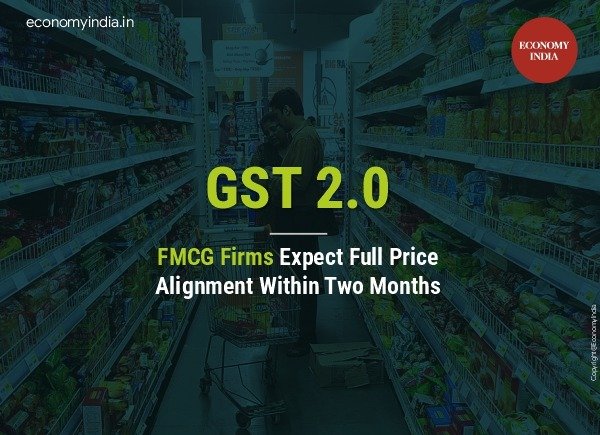

Consumers to see deeper price corrections as companies gradually pass on GST benefits
New Delhi (Economy India): With the rollout of GST 2.0 reforms slashing indirect tax rates on a wide range of essential goods, Fast-Moving Consumer Goods (FMCG) companies are cautiously adjusting product prices. Industry insiders suggest that while reductions of ₹2, ₹5, and ₹10 have already been announced across categories, full alignment with the new GST rates will take up to two months as firms recalibrate pricing, distribution, and inventory strategies.
Gradual Price Adjustments Already Visible
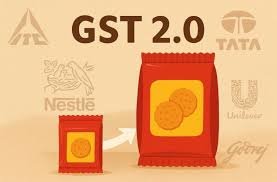
Several leading FMCG firms have begun cutting prices of household essentials including packaged foods, soaps, shampoos, and detergents. Companies such as Hindustan Unilever, ITC, Nestlé, and Dabur have initiated partial reductions across key SKUs, ensuring that immediate consumer benefits are visible.
Executives note that while the GST rate cuts offer scope for larger reductions, the process is being phased to avoid supply chain disruptions. “Manufacturers have already reduced prices by ₹2, ₹5, and ₹10 on multiple categories. We expect a complete pass-through of the GST benefit to consumers within the next two months,” said an industry official.


Why the Delay in Full Price Pass-Through?
FMCG companies face a unique challenge in aligning product pricing swiftly. Stocks manufactured and distributed under old GST rates remain in trade channels, leading to temporary discrepancies in consumer pricing.
- Inventory absorption: Products already dispatched before GST 2.0 implementation carry higher tax incidence, requiring clearance before fresh pricing takes full effect.
- Packaging and labeling: Manufacturers need time to reprint Maximum Retail Price (MRP) labels, adjust packaging designs, and secure regulatory approvals.
- Distribution complexity: With thousands of distributors and millions of retail outlets, uniform price rollout requires careful synchronization.
Experts suggest that these operational hurdles explain the two-month adjustment period.
Consumers Likely to Benefit More in November–December
According to analysts, the real impact of GST 2.0 on household budgets will be visible by November–December, when festive demand peaks. By then, old inventories would have cleared, and the revised lower MRPs will dominate retail shelves.
“Once the transitional phase ends, consumers will see deeper reductions, particularly in staples, personal care, and packaged food categories,” said a retail market analyst.
Impact on Household Consumption and Economy
The government has projected that GST 2.0 reforms will inject nearly ₹2 lakh crore into the economy. FMCG is expected to be one of the largest transmission channels of this liquidity.
- Boost to rural demand: Lower product prices can accelerate consumption in semi-urban and rural markets, which account for more than 40% of FMCG sales.
- Support to small retailers: As prices normalize, kirana stores and small shopkeepers will see improved margins and higher customer footfalls.
- Higher savings for households: Reduced daily expenses on essentials will leave more disposable income for consumers, indirectly supporting discretionary spending.
Industry Leaders Welcome Reform
Company executives have broadly welcomed GST 2.0 reforms, describing them as a “game changer” for consumption-driven sectors.
- Hindustan Unilever has indicated price cuts in soaps and detergents, categories that account for significant volumes in rural markets.
- Nestlé India has lowered prices on select packaged food products.
- ITC and Dabur have also confirmed reductions across household staples and personal care ranges.
An FMCG industry association spokesperson noted: “The simplified GST structure has given us fiscal space. Consumers will be the ultimate beneficiaries as companies gradually align prices.”
Policy Angle: Government’s Push for Transparency
The government has directed companies to pass on GST benefits transparently to consumers, reinforcing its anti-profiteering mandate. Officials from the Ministry of Finance have also hinted at closer monitoring of compliance, especially in sectors with high consumption elasticity.
Economists argue that the effectiveness of GST 2.0 will be measured not only by inflation control but also by how quickly consumer-facing industries transmit tax cuts into tangible benefits.
A Turning Point for FMCG and Consumption
The GST 2.0 reforms mark a decisive moment for India’s consumption economy. With FMCG companies expected to complete price adjustments within two months, households will witness meaningful savings on everyday goods before the year ends.
As Finance Minister Nirmala Sitharaman emphasized recently, the new GST framework is designed to leave “more money in people’s hands.” The coming festive season could therefore serve as a litmus test for how successfully tax reforms translate into higher consumption and economic momentum.
(Economy india)