New Delhi (Economy India) India could face sharp fuel price pressure, market volatility, and a surge in gold prices if the intensifying conflict between the United States, Israel, and Iran turns prolonged and disrupts global oil routes — particularly the Strait of Hormuz, one of the world’s most critical energy corridors.
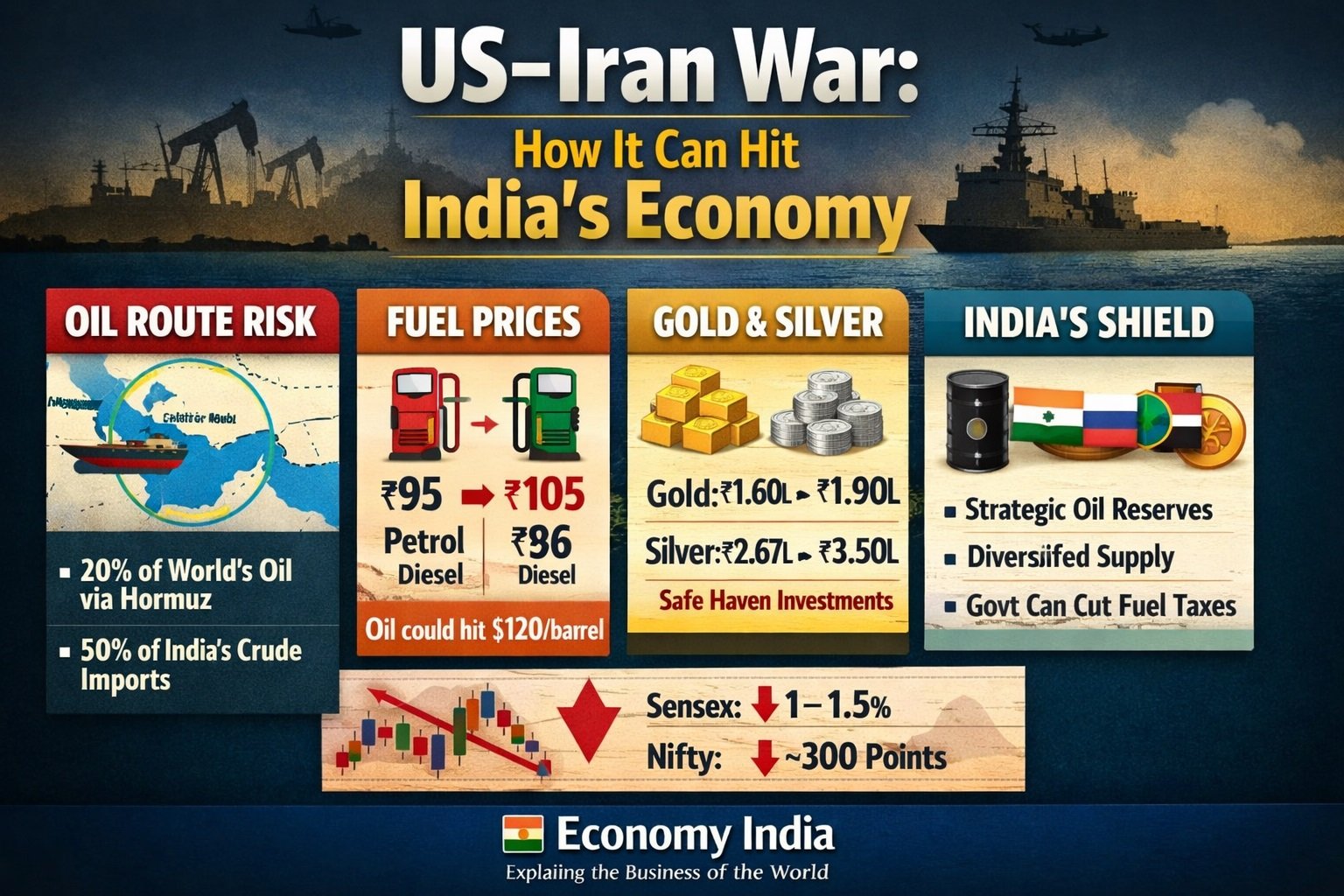
The geopolitical shock follows reports of the killing of Iran’s Supreme Leader Ayatollah Ali Khamenei during US–Israel military strikes. With Iran weighing retaliatory options, analysts warn that any blockade of the Strait of Hormuz could push crude oil prices above $100–120 per barrel, directly impacting India’s economy.
India imports nearly 90% of its crude oil needs, making it extremely sensitive to supply-side disruptions in West Asia.
Fuel Prices Under Pressure: Petrol May Touch ₹105, Diesel ₹96
If crude prices surge sharply, retail fuel prices in India could rise by ₹10–12 per litre, according to market estimates.
- Petrol (Delhi): ₹95 → ₹105 per litre
- Diesel (Delhi): ₹88 → ₹96 per litre
Nearly 50% of India’s crude oil imports transit through the Strait of Hormuz, sourced mainly from Iraq, Saudi Arabia, the UAE, and Kuwait. Any disruption would immediately squeeze global supply.
Why Fuel Prices Are Vulnerable
- Brent crude is currently trading around $70 per barrel
- A Hormuz blockade could cut nearly 20% of global petroleum flows
- Prices could spike to $100–120 per barrel in extreme scenarios
Who Decides Fuel Prices in India?
While fuel prices are officially deregulated, the final decision remains politically sensitive.
How Pricing Works:
- Oil Marketing Companies (OMCs) revise prices based on:
- International crude averages (15-day window)
- USD–INR exchange rate
- However, central and state taxes account for a large share of retail prices
In times of war or inflationary risk, the Government of India may:
- Advise OMCs to delay price hikes
- Reduce excise duties to soften the blow on consumers
This makes fuel pricing as much a political decision as an economic one.

Gold and Silver: Safe-Haven Rush Intensifies
With geopolitical uncertainty rising, investors traditionally move toward safe-haven assets, especially gold.
Price Outlook (Expert Estimates):
- Gold: ₹1.60 lakh → ₹1.90 lakh per 10 grams
- Silver: ₹2.67 lakh → ₹3.50 lakh per kg
According to commodity expert Ajay Kedia, prolonged conflict could significantly boost precious metal demand as investors hedge against risk.
Why Gold Rallies During War:
- Currency volatility
- Stock market uncertainty
- Inflationary pressures from oil shocks
- Central bank buying
Stock Market Impact: Short-Term Shock Likely
Equity markets are expected to react negatively in the near term.
Market Estimates:
- Sensex: Down 1–1.5% (≈1,300 points)
- Nifty: Down up to 300 points
During geopolitical crises, global investors often exit risk assets and shift funds into:
- Gold
- US Treasury bonds
- Dollar-denominated assets
Indian markets are not immune to such global risk-off sentiment.
Why the Strait of Hormuz Matters So Much
The Strait of Hormuz is one of the world’s most strategic maritime chokepoints.
Key Facts:
- Length: 167 km
- Narrowest point: 33 km
- Handles:
- ~20% of global petroleum trade
- ~20% of global LNG shipments
- Daily traffic:
- 17.8–20.8 million barrels of oil
- Iran alone exports 1.7 million barrels per day via this route
India’s Trade Exposure:
- Over 10% of India’s non-oil exports pass through Hormuz
- Includes:
- Basmati rice
- Tea
- Spices
- Engineering goods
Any disruption would impact both imports and exports, widening India’s trade deficit.
Can Iran Really Block Hormuz?
Following the death of its Supreme Leader, Iran is evaluating several retaliation options:
- Targeting US military bases
- Missile attacks on Israeli territories
- Blocking the Strait of Hormuz — its most powerful geopolitical lever
However, analysts note that closing Hormuz would also hurt Iran badly:
- Iran would be unable to export its own oil
- China, Iran’s largest oil buyer, would face supply disruptions
- Diplomatic fallout with key partners could worsen Iran’s isolation
Saudi Arabia’s East–West Pipeline: A Partial Alternative
As a contingency, Saudi Arabia can bypass Hormuz using its East–West Pipeline.
Pipeline Details:
- Length: 746 miles
- Route: Eastern oil fields → Red Sea terminals
- Capacity: 5 million barrels per day
While helpful, this alternative cannot fully offset a complete Hormuz shutdown, especially for Asian buyers like India.
India’s Preparedness: Diversification and Strategic Reserves
Indian authorities are actively preparing for worst-case scenarios.
Key Measures:
- Increasing crude purchases from:
- United States
- Russia
- West Africa
- Latin America
- Using Strategic Petroleum Reserves (SPR) if needed
- Indian refiners hold:
- ~10 days of crude inventory
- 5–7 days of fuel stock
These buffers can handle short-term disruptions, but prolonged conflict would raise costs significantly.
Macro Impact on India: Inflation, Rupee, Growth
A sustained oil shock could trigger:
- Higher inflation (fuel, transport, food)
- Pressure on the Indian rupee
- Wider fiscal deficit
- Slower GDP growth
India’s policymakers would face tough trade-offs between price stability, fiscal discipline, and political considerations.
Economy India View
While India is unlikely to face immediate oil shortages, the economic ripple effects of a prolonged US–Iran conflict could be substantial. Fuel prices, inflation expectations, gold demand, and investor sentiment are all at risk.
The coming weeks will be crucial in determining whether this crisis remains a short-term geopolitical shock or evolves into a global economic stress event.
(Economy India)