
• ABOUT US
  • CONTACT
  • TEAM
  • TERMS & CONDITIONS
  • GUEST POSTS
Thursday, October 8, 2026
  • Login
Economy India
No Result
View All Result
  • Home
  • Economy
  • Business
  • Finance
  • Gold & Silver
  • National
  • State
  • People
  • Companies
  • More
    • Insurance
    • Interview
    • Featured
    • Health
    • Technology
    • Entrepreneurship
    • Opinion
    • CSR
    • Stories
  • Home
  • Economy
  • Business
  • Finance
  • Gold & Silver
  • National
  • State
  • People
  • Companies
  • More
    • Insurance
    • Interview
    • Featured
    • Health
    • Technology
    • Entrepreneurship
    • Opinion
    • CSR
    • Stories
No Result
View All Result
Economy India
No Result
View All Result
Home Economy

Economic growth goes down when number of wet days with extreme rainfall go up: Study

by Economy India
January 13, 2022
Reading Time: 3 mins read
FEATURED IMAGE ECONOMY INDIA 1 1
SHARESHARESHARESHARE
india csr awards
ADVERTISEMENT

According to a report in Business Standard, A study by a team of Potsdam scientists found that economic growth goes down when the number of wet days and days with extreme rainfall go up.

Rich countries are most severely affected and herein the manufacturing and service sectors, according to their study now published as a cover story in the renowned science journal Nature, as per the press release by Potsdam Institute for Climate Impact Research (PIK).

The data analysis of more than 1.500 regions over the past 40 years shows a clear connection and suggests that intensified daily rainfall driven by climate change from burning oil and coal will harm the global economy, the report said.

Macro Economic

“This is about prosperity, and ultimately about people’s jobs. Economies across the world are slowed down by more wet days and extreme daily rainfall – an important insight that adds to our growing understanding of the true costs of climate change,” said Leonie Wenz from the Potsdam Institute for Climate Impact Research (PIK) and the Mercator Research Institute on Global Commons and Climate Change (MCC) who led the study.

19th India CSR Leadership Summit 2026
ADVERTISEMENT

“Macro-economic assessments of climate impacts have so far focused mostly on temperature and considered – if at all – changes in rainfall only across longer time scales such as years or months, thus missing the complete picture,” the report said.

“While more annual rainfall is generally good for economies, especially agriculturally dependent ones, the question is also how the rain is distributed across the days of the year. Intensified daily rainfall turns out to be bad, especially for wealthy, industrialized countries like the US, Japan, or Germany.”

Maximilian Kotz, first author of the study and also at the Potsdam Institute said they identify a number of distinct effects on economic production, yet the most important one really is from extreme daily rainfall.

“This is because rainfall extremes are where we can already see the influence of climate change most clearly and because they are intensifying almost everywhere across the world.”

Economic Effects

According to the release, the analysis statistically evaluates data of sub-national economic output for 1554 regions worldwide in the period 1979-2019, collected and made publicly available by MCC and PIK.

“The scientists combine these with high-resolution rainfall data. The combination of ever increasing detail in climatic and economic data is of particular importance in the context of rain, a highly local phenomenon, and revealed the new insights,” it said.

“By loading the Earth’s atmosphere with greenhouse gases from fossil power plants and cars, humanity is heating the planet. Warming air can hold more water vapour that eventually becomes rain. Although atmospheric dynamics make regional changes in annual averages more complicated, daily rainfall extremes are increasing globally due to this water vapour effect.”

The study reveals that it’s precisely the fingerprint of global warming in daily rainfall which have hefty economic effects that have not yet been accounted for but are highly relevant, says co-author Anders Levermann, Head of the Potsdam Institute’s Complexity Science domain, professor at Potsdam University and researcher at Columbia University’s Lamont Doherty Earth Observatory, New York.

“Taking a closer look at short time scales instead of annual averages helps to understand what is going on: it’s the daily rainfall which poses the threat. It’s rather the climate shocks from weather extremes that threaten our way of life than the gradual changes. By destabilizing our climate we harm our economies. We have to make sure that our burning of fossil fuels does not destabilize our societies, too. (Business Standard)

Tags: Economic EffectsEconomy IndiaEconomy NewsIndian EconomyMacro EconomicRainfall
19th India CSR Leadership Summit 2026
Economy India

Economy India

Economy India is one of the largest media on the Indian economy. It provides updates on economy, business and corporates and allied affairs of the Indian economy. It features news, views, interviews, articles on various subject matters related to the economy and business world.

Related Posts

Out of 42 PSEs in J&K, 26 Reported Losses or Were Inactive as of March 2023: CAG
Economy

Out of 42 PSEs in J&K, 26 Reported Losses or Were Inactive as of March 2023: CAG

October 2, 2026
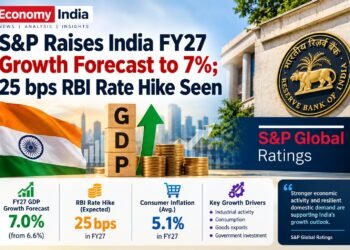
S&P Raises India FY27 GDP Growth Forecast to 7%, Sees 25 bps RBI Rate Hike
Economy

S&P Raises India FY27 GDP Growth Forecast to 7%, Sees 25 bps RBI Rate Hike

September 23, 2026
ACFI Seeks Rs 5,000-7,500 Crore Scheme to Reduce India’s Dependence on China for Agrochemical Inputs
Economy

ACFI Seeks Rs 5,000-7,500 Crore Scheme to Reduce India’s Dependence on China for Agrochemical Inputs

September 21, 2026
Moody’s Raises India’s FY27 Growth Forecast to 7%, Flags Crude Oil and El Niño Risks
Economy

Moody’s Raises India’s FY27 Growth Forecast to 7%, Flags Crude Oil and El Niño Risks

September 18, 2026
Modi Pitches India as Trusted Manufacturing Hub, Calls for Deeper Semiconductor Ecosystem
Economy

Modi Pitches India as Trusted Manufacturing Hub, Calls for Deeper Semiconductor Ecosystem

September 18, 2026
NBFID Hosts Infrastructure Conclave 2026 to Mobilise Long-Term Capital for India’s Infrastructure Growth
Economy

NBFID Hosts Infrastructure Conclave 2026 to Mobilise Long-Term Capital for India’s Infrastructure Growth

September 18, 2026
Next Post
FEATURED IMAGE ECONOMY INDIA 1 1

PowerGrid and Africa50 in Joint Development Agreement, to pioneer Africa’s first transmission PPP project

ESG Professional Network
ADVERTISEMENT

LATEST NEWS

Out of 42 PSEs in J&K, 26 Reported Losses or Were Inactive as of March 2023: CAG

PM Modi Speaks to Flydubai Pilot Captain Smit Machchhar, Praises His Courage

‘Invest Maharashtra’ Platform Launched; 67 MoUs With Proposed Investment of Rs 8.57 Lakh Crore Signed

Indian Women’s Recurve Team Wins Historic Asian Games Gold; Mixed Pair Reaches Final

Five Killed, 21 Injured as Truck Hits Pickup Van on Samruddhi Highway in Amravati

TCIL Pays Government Rs 43.86 Crore Dividend for FY26

Corporate Credit Profile Remains Strong in H1FY27 Despite West Asia Conflict: Ind-Ra

INDIA Bloc Meets Over SIR Row; Joint Agitation, CEC Removal Motion on Agenda

  • ABOUT US
  • CONTACT
  • TEAM
  • TERMS & CONDITIONS
  • GUEST POSTS

Copyright © 2024 - Economy India | All Rights Reserved

Welcome Back!

Login to your account below

Forgotten Password?

Retrieve your password

Please enter your username or email address to reset your password.

Log In
No Result
View All Result
  • Home
  • Economy
  • Business
  • Finance
  • Gold & Silver
  • National
  • State
  • People
  • Companies
  • More
    • Insurance
    • Interview
    • Featured
    • Health
    • Technology
    • Entrepreneurship
    • Opinion
    • CSR
    • Stories

Copyright © 2024 - Economy India | All Rights Reserved