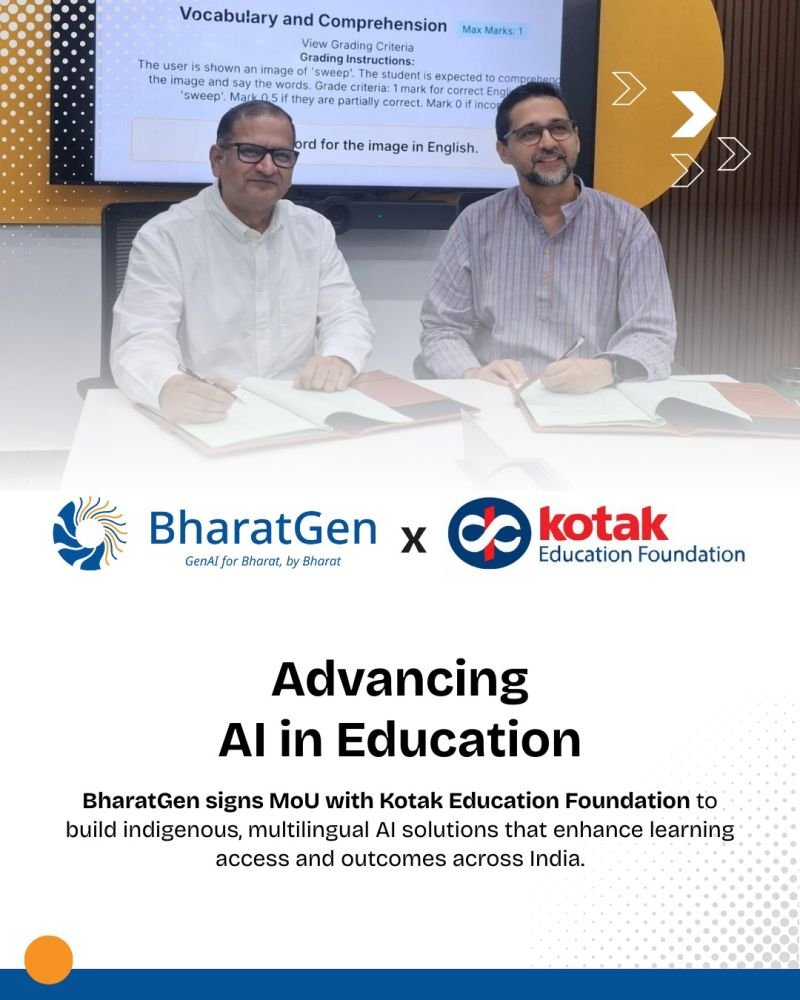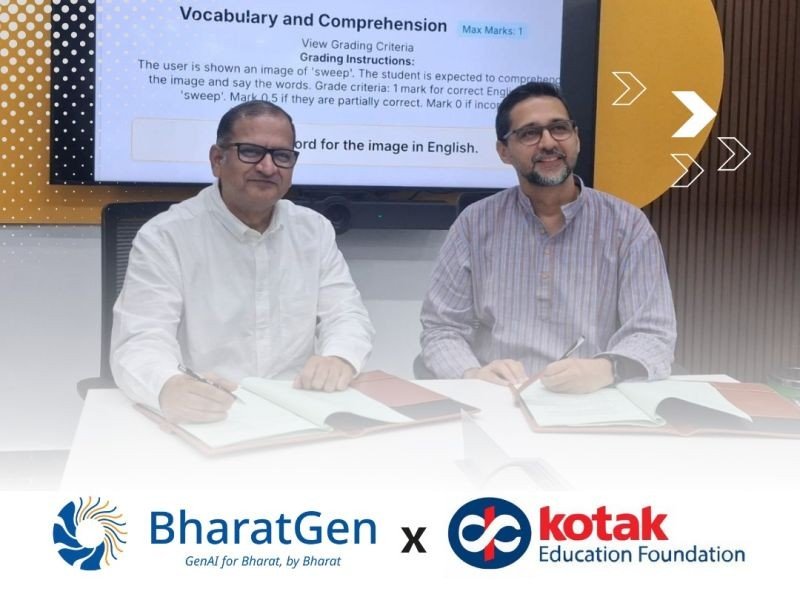
Mumbai ( Economy India): India’s education sector is set to witness a significant transformation with the signing of a strategic Memorandum of Understanding (MoU) between Kotak Education Foundation (KEF) and BharatGen Technology Foundation. The collaboration aims to strengthen and expand the deployment of indigenous, multilingual Artificial Intelligence (AI) solutions to improve learning outcomes and widen access to quality education across the country.
The partnership reflects a growing alignment between education-focused CSR initiatives and India’s national AI and digital public infrastructure goals, positioning technology as a key enabler of inclusive and equitable learning.
A Strategic Collaboration at the Intersection of Education and AI
The MoU was signed in Mumbai by Ganesh Raja, Chief Executive Officer of Kotak Education Foundation, and Rishi Bahl, Chief Executive Officer of BharatGen Technology Foundation.
Under the agreement, the two organizations will collaborate to design, develop, and deploy India-first AI solutions that are culturally contextual, linguistically inclusive, and scalable across diverse education settings—from urban classrooms to remote and underserved communities.

According to officials familiar with the partnership, the focus will be on responsible AI adoption, ensuring transparency, fairness, and accessibility while leveraging cutting-edge technologies such as natural language processing (NLP), adaptive learning systems, and AI-powered assessment tools.
Why AI in Education Matters for India
India’s education system caters to over 260 million students, making it one of the largest in the world. Despite significant progress in enrollment and digital access, challenges persist in areas such as learning outcomes, teacher capacity, language barriers, and regional disparities.
AI is increasingly viewed as a transformative tool capable of addressing these structural gaps by:
- Personalising learning experiences for students
- Supporting teachers with intelligent content and assessments
- Enabling multilingual education in regional and tribal languages
- Improving data-driven decision-making in education delivery
However, experts caution that imported or generic AI models often fail to reflect India’s linguistic, cultural, and socio-economic realities, underscoring the importance of indigenous AI development.
This is where the KEF–BharatGen partnership assumes strategic importance.
Kotak Education Foundation’s Role in Education Transformation
Kotak Education Foundation, the CSR arm backed by Kotak Group, has built a strong reputation for working at the grassroots level to support students from underserved communities, particularly in urban low-income areas.
KEF’s programs focus on:
- Foundational learning and numeracy
- Secondary and higher education support
- Employability and career readiness
- Teacher capacity building
By integrating AI into its education initiatives, KEF aims to scale impact without compromising inclusivity, ensuring technology enhances—not replaces—human-centered learning.
Speaking on the collaboration, Ganesh Raja noted that AI must be seen as a tool to empower both learners and educators, rather than as a standalone technological solution.
“For AI to truly make a difference in education, it must be designed for India, in India, and with India’s learners at the centre,” he said.
BharatGen Technology Foundation: Building India’s AI Backbone
BharatGen Technology Foundation plays a critical role in India’s emerging AI ecosystem by focusing on foundational AI models, datasets, and platforms tailored to Indian contexts.
The foundation is known for its work on:
- Multilingual and multimodal AI models
- Open, interoperable AI frameworks
- Ethical and responsible AI governance
- Collaboration with academia, startups, and public institutions
Through this MoU, BharatGen will bring its technical expertise and research capabilities to education-focused use cases, helping translate advanced AI research into real-world classroom applications.
Rishi Bahl emphasized that education is one of the most impactful sectors for responsible AI deployment.
“When designed thoughtfully, AI can democratise access to quality education and help bridge long-standing learning gaps across regions and languages,” he said.
Focus on Multilingual and Inclusive AI Solutions
One of the defining features of the collaboration is its emphasis on multilingual AI, a critical requirement in a country where students learn in more than 20 official languages and hundreds of dialects.
The partnership will work on AI systems that can:
- Deliver learning content in multiple Indian languages
- Support students who are first-generation learners
- Enable adaptive assessments aligned with varied learning levels
- Assist teachers in multilingual classrooms
By doing so, the initiative aligns closely with the National Education Policy (NEP) 2020, which advocates mother-tongue-based education and technology-enabled learning.
Strengthening Learning Outcomes Through AI
Beyond access, the collaboration places strong emphasis on measurable learning outcomes. AI-driven tools are expected to help identify learning gaps early and provide targeted interventions.
Potential applications include:
- AI-powered diagnostic assessments
- Personalised learning pathways
- Smart tutoring and feedback systems
- Data dashboards for educators and administrators
Education experts believe such tools could significantly reduce dropout rates and improve student retention, particularly in secondary education.
CSR, Technology, and Public Good: A Converging Agenda
The MoU highlights a broader shift in India’s CSR landscape, where corporates are moving beyond traditional philanthropy towards technology-led, outcome-oriented social investments.
By integrating AI into education CSR initiatives, organizations like KEF are:
- Enhancing scalability and efficiency
- Improving accountability through data
- Aligning CSR with national development priorities
This approach mirrors India’s broader digital public infrastructure success stories, such as digital payments and identity systems, now being extended into social sectors like education and healthcare.
Responsible and Ethical AI at the Core
Both KEF and BharatGen have underscored their commitment to ethical AI practices, including:
- Data privacy and child protection
- Bias mitigation in algorithms
- Transparency in AI decision-making
- Human oversight in learning processes
With increasing scrutiny around AI use in sensitive sectors, this emphasis on responsibility is expected to set benchmarks for future education-tech collaborations.
Implications for India’s EdTech Ecosystem
The partnership also carries implications for India’s rapidly evolving EdTech ecosystem. While private EdTech platforms have driven innovation, there is growing recognition of the need for public-interest AI solutions that prioritize inclusion over profitability.
By working with a foundation-driven, open-innovation approach, the KEF–BharatGen collaboration could:
- Encourage open-source AI adoption
- Support startups building India-centric education tools
- Foster academia–industry–CSR partnerships
Industry observers say such models are critical to ensuring that AI benefits reach the last-mile learner, not just digitally privileged segments.
Looking Ahead: Scaling Impact Nationwide
Over the coming months, the two organizations are expected to pilot AI-enabled education solutions across select geographies before scaling them nationwide.
The success of these pilots could inform broader policy frameworks and encourage replication by other CSR-led education initiatives.
As India positions itself as a global AI hub, collaborations like this signal that AI leadership is not just about technological prowess, but about social impact and inclusive growth.
A Step Towards Future-Ready Education
The Kotak Education Foundation–BharatGen Technology Foundation partnership represents a forward-looking vision for Indian education, where technology, policy, and social responsibility converge.
By focusing on indigenous innovation, multilingual inclusion, and ethical AI, the initiative aligns with India’s aspiration to harness technology for equitable development.
As education systems worldwide grapple with post-pandemic learning gaps and rapid technological change, India’s approach—grounded in scale, diversity, and responsibility—may well offer a model worth watching.
📌 Economy India Takeaway
This MoU is not just a partnership between two organizations—it is a signal of how AI-driven, CSR-backed, and policy-aligned initiatives can redefine education delivery in India, ensuring that the benefits of technology reach every learner, everywhere.
(Economy India)