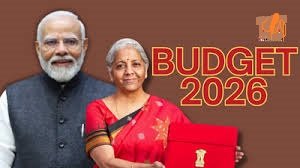

| New Delhi (Economy India): India’s macroeconomic fundamentals remain resilient and growth-oriented, with the Union Budget 2026-27 projecting strong economic expansion, sustained domestic demand, and a calibrated path of fiscal consolidation. Presenting the Budget in Parliament, Union Finance and Corporate Affairs Minister Nirmala Sitharaman said India’s economic outlook continues to be positive, supported by structural reforms, infrastructure-led investment, and stable inflation.
According to the First Advance Estimates, India’s real Gross Domestic Product (GDP) is projected to grow 7.4% in FY 2025-26, while nominal GDP growth is estimated at 10% in FY 2026-27. The government underlined that the economy has demonstrated resilience despite global headwinds, including geopolitical uncertainties and volatile trade conditions.

Services Sector Leads Growth Momentum
The services sector continues to be the primary engine of growth, expanding by 9.1%, driven by robust performance in finance, information technology, transport, tourism, and professional services. Manufacturing and construction are estimated to grow by around 7%, reflecting steady infrastructure activity, while agriculture is expected to record a 3.1% growth, supported by improved productivity and government support measures.
Economists view the sectoral balance as a sign of economic maturity, with services anchoring growth while industry and agriculture provide stability.
Domestic Consumption at a 12-Year High
Domestic demand remains the cornerstone of India’s growth trajectory. The Budget projects Private Final Consumption Expenditure (PFCE) to grow by 7% in FY 2026, accounting for 61.5% of GDP—the highest share recorded in the last 12 financial years.
Government consumption expenditure is also expected to rise sharply by 5.2%, compared to 2.3% in the previous year. Indicators such as rising UPI transactions, increased air and rail passenger traffic, and sustained urban and rural consumption trends point to broad-based demand recovery.
Investment Cycle Strengthens Further
Investment activity remains robust, with Gross Fixed Capital Formation (GFCF) projected to rise by 7.8% in FY 2026. The government highlighted that the investment-to-GDP ratio has remained close to 30% over the past decade, reflecting sustained confidence in India’s medium-term growth prospects.
To reinforce this momentum, the Budget allocates ₹12.22 lakh crore as direct central capital expenditure. Additionally, ₹4.93 lakh crore has been earmarked as grants to states for the creation of capital assets. Together, these components translate into an effective capital expenditure of ₹17.15 lakh crore, equivalent to 4.4% of GDP in FY 2026-27.
Strong Support to States Through Tax Devolution
In line with the recommendations of the 16th Finance Commission, the Centre has retained a 41% share of tax devolution to states. For FY 2026-27, states are expected to receive ₹15.26 lakh crore as tax devolution, along with ₹1.4 lakh crore in Finance Commission grants.
This brings the total resource transfer to states to ₹16.56 lakh crore, underscoring the government’s commitment to cooperative federalism and empowering states to accelerate capital formation and development spending.
Fiscal Consolidation on Track
The government reiterated its commitment to fiscal discipline while prioritising growth. The fiscal deficit for FY 2026-27 has been pegged at 4.3% of GDP, improving from 4.4% in FY 2025-26. The revenue deficit is projected at 1.5%, while the effective revenue deficit is expected to remain contained at 0.3%.
The Centre’s debt-to-GDP ratio is estimated at 55.6% in FY 2026-27, down from 56.1% in the previous year. The medium-term target is to bring this ratio close to 50% by FY 2030-31, reinforcing macroeconomic stability.
Tax Revenues Show Sustained Strength
Total gross tax revenue for FY 2026-27 is estimated at ₹44.04 lakh crore, marking an 8% increase over revised estimates of the previous year. Direct taxes continue to dominate, contributing over 61% of total tax revenues.
The tax-to-GDP ratio is projected at 11.2%, reflecting improved compliance, digitisation, and formalisation of the economy.
External Sector Resilient Despite Global Pressures
Despite a challenging global trade environment and rising tariff barriers, India’s external sector has demonstrated resilience. Total exports (goods and services) reached USD 825.3 billion in FY 2025, maintaining momentum into FY 2026.
Service exports grew by 6.5%, while merchandise exports such as textiles registered growth despite trade restrictions in key markets. Foreign Direct Investment (FDI) inflows stood at USD 81 billion in FY 2025, with FY 2026 recording the highest inflows in the first seven months of any financial year so far.
The current account deficit narrowed significantly to 0.8% of GDP in the first half of FY 2026, compared to 1.3% in the corresponding period of FY 2025.
Outlook: Growth with Stability
The government emphasized that structural reforms, digital transformation, labour market improvements, and sustained public investment are reshaping India’s economic architecture. With stable inflation, strengthening private investment, and prudent fiscal management, India remains one of the fastest-growing major economies globally.
As the Budget 2026-27 signals, India’s development strategy continues to balance growth, stability, and inclusiveness, aligning with the long-term vision of Viksit Bharat.
— Economy India