Trump and Xi meet in an unplanned yet decisive 100-minute discussion leading to a breakthrough trade deal.
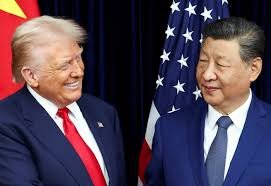
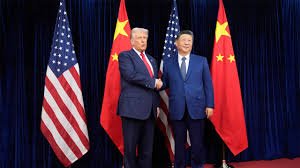
Busan I South Korea (Economy India): In a surprise diplomatic move, U.S. President Donald Trump and Chinese President Xi Jinping met at South Korea’s Busan Airport on Thursday and reached a breakthrough trade deal—the first of its kind in nearly six years.
According to President Trump, the U.S. has reduced tariffs on Chinese goods by 10%, while China has agreed to purchase large quantities of American soybeans. Although the deal has not yet been formally signed, both sides have confirmed that the agreement is “complete in principle.”
🔹 A Historic Airport Meeting
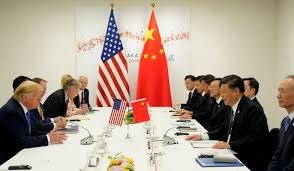
The 100-minute-long meeting took place inside a secure hangar at Busan’s Gimhae Airbase, where both leaders met with their key ministers and trade representatives.
ADVERTISEMENT
Due to tight schedules, the two presidents decided to meet at the airport itself — marking one of the most unconventional yet consequential bilateral meetings in recent years.
“This was a productive meeting. President Xi is a strong negotiator — maybe too strong — but I respect him. We know each other very well,” said Trump aboard Air Force One while returning to Washington.
🔹 Tariff Relief: From 57% to 47%
During the media briefing, Trump revealed that the average U.S. tariff on Chinese imports will drop from 57% to 47% immediately. This cut reverses part of Trump’s earlier tariff increases — including the 20% “fentanyl tariff” imposed earlier this year, which he said had been “too high.”
“I imposed that tariff to hold China accountable for fentanyl deaths in America. But I’ve now reduced it by 10%, effective immediately,” Trump clarified.
Trump-Xi Trade Deal Finalized at South Korea Airport: Tariffs Cut by 10%, China to Resume Soybean Imports
🔹 China’s Commitment: Massive Soybean Imports
Xi Jinping reportedly agreed to restart large-scale purchases of American soybeans and other agricultural goods — a relief for U.S. farmers who have faced record stockpiles since Beijing halted purchases earlier this year.
Analysts note that soybean exports were one of the hardest-hit commodities in the ongoing U.S.-China trade tensions, with American farmers losing billions of dollars in the past two years.
🔹 Xi’s Message: “We Seek Cooperation, Not Confrontation”
In a statement released by China’s Xinhua News Agency, President Xi said Beijing “never seeks to challenge or replace any country” but aims to “do its work better and share opportunities for development.”
“China and the United States should avoid the vicious cycle of retaliation. We must pursue cooperation that benefits both nations,” Xi said.
He added that both countries should support each other during next year’s APEC Summit (hosted by China) and G20 Summit (hosted by the U.S.), emphasizing continued dialogue on global stability.
Rare Earths, AI Chips, and High-Tech Cooperation
Trump also confirmed that long-standing disputes over rare earth materials have been resolved.
“The rare earths issue is fixed. This is not just a win for the U.S., but for the entire world,” Trump said.
Both sides also discussed semiconductor cooperation, with Trump noting that China and Nvidia would soon engage in direct talks about chip purchases, though he clarified that Nvidia’s most advanced “Blackwell” AI chips remain off-limits.
🔹 Investment and Future Visits
Trump announced that China plans to increase investment in U.S. sectors like automotive manufacturing and artificial intelligence. He also confirmed that he will visit China in April 2026, followed by Xi Jinping’s reciprocal visit to the U.S. later that year.
“I’ll visit China in April, and Xi will come to the U.S. later. It could be Palm Beach or Washington D.C.,” Trump said.
Trump-Xi Trade Deal Finalized at South Korea Airport: Tariffs Cut by 10%, China to Resume Soybean Imports
Global Market Reaction
Following the news, Chinese and Asian stock markets rallied.
The Shanghai Composite Index rose 0.2% to a 10-year high at 4,025.70,
The Hang Seng Index climbed 0.6%,
And U.S. futures reacted positively, signaling optimism for easing global trade tensions.
However, analysts caution that the details of the deal — particularly around technology exports and rare earth supply — will determine its long-term impact.
Symbolism Beyond Trade
The meeting marked the first Trump-Xi encounter since 2019, symbolizing a potential reset in U.S.-China relations after years of escalating tariffs, tech bans, and military tensions over Taiwan and the South China Sea.
Political experts view this meeting as part of Trump’s strategy to project global leadership ahead of the 2026 U.S. elections.
“Trump needed a diplomatic win — and this trade truce with Xi gives him exactly that,” said Washington-based analyst Karen Douglas.
Challenges Ahead
Despite the positive tone, several issues remain unresolved:
The U.S. still restricts China’s access to advanced AI processors.
Beijing continues to assert control over Taiwan.
Mutual suspicion over cyber espionage persists.
Economists warn that without structural reforms, “temporary tariff cuts” may not translate into long-term stability.
A Tactical Pause, Not a Permanent Peace
While the Busan Airport Deal may calm global markets, experts believe it represents a temporary truce rather than a complete trade reconciliation.
Still, for now, the handshake between Trump and Xi — after six years of economic friction — sends a clear message: the world’s two biggest economies are talking again.
Economy India is one of the largest media on the Indian economy. It provides updates on economy, business and corporates and allied affairs of the Indian economy. It features news, views, interviews, articles on various subject matters related to the economy and business world.